Most people talk about winter like it’s scenery. Snow, lights, football games, family traditions, etc. I used to see it that way too. Then snow and ice became something different: a surface I had to negotiate, not admire.
Last week’s storm was a reminder.
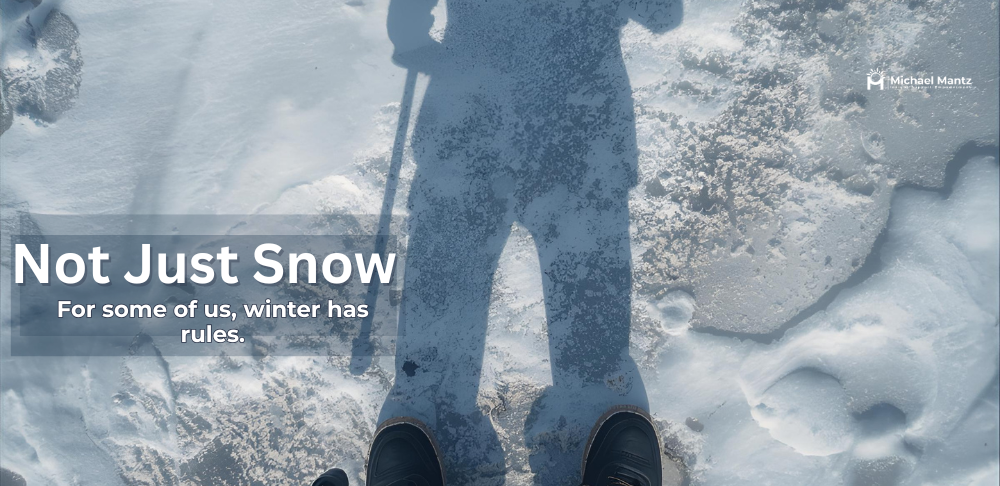
The sidewalks were technically “cleared,” but if you walk the way I walk, you notice the thin film others miss. That slick layer that looks harmless but isn’t. The kind you feel through your shoes before you even see it. By the time I reached my car, the sidewalk gave way to what might as well have been a moat of ice. Not a harmless patch……a ring of it.
That’s when winter started for me.
One hand on the car and walking stick in the other. Slow, calculated inches instead of steps.
People don’t think about what it takes just to get to your vehicle when you don’t trust your footing. Clearing snow off the windshield becomes a coordinated maneuver – scrape, shift weight, steady, breathe. The wipers were frozen in place and the glass was coated in ice. Every movement required a strategy.
I wasn’t thinking deep thoughts or life lessons. Instead I was thinking: Don’t fall. Not here. Not today.
That’s winter with Ataxia.
If you’ve ever spent a winter with Ataxia, you know it teaches you things most people never have to think about.
Snow and ice slow everyone down, but it changes us differently.
If you walk with balance issues, winter forces you into a mindset most people don’t have to think about:
- Where is my next stable step?
- How do I reach this without falling?
- What happens if I fall and noone is around?
These are the thoughts that define what winter with Ataxia really looks like.
That last one is real.
Ice humbles everyone, no matter how capable you are. But when balance is a problem, winter doesn’t just slow you down, it raises the stakes.
That’s when I realized something simple but important:
My walking stick was helping, but not enough for ice.
Anyone who has lived through a harsh winter with Ataxia knows that sometimes tools aren’t about progression, they’re about survival.
My PT is now working with their supplier to find a rollator fitted to me. Not for daily life (I’m not there yet), but because from my door to my car on ice is a different world.
People assume mobility tools mean progression, but sometimes they just mean wisdom.
The Emotional Weight No One Sees
Here’s the part that rarely gets talked about:
There’s the physical work of staying upright. And then there’s the quieter work (for me) – not wanting to be seen as struggling.
Ataxia makes you think like that. Not all the time but just enough. And winter magnifies it. When really… it’s survival.
That’s why I brought the stick, not because I needed it to walk every step, but because it signals something my body can’t explain for itself.
It makes winter visible in a world that doesn’t see it.
Someone Out There Gets This
Maybe you’re reading this because winter scares you more than summer, your toes catch more when it’s cold, or you walk differently than you used to – but you haven’t said it out loud.
And maybe you’ve stood on a slippery driveway like I did and thought:
Just don’t fall.
This is the unspoken truth of living with balance challenges or Ataxia:
Winter requires planning others don’t recognize.
When you have balance issues, your brain isn’t multitasking, it’s locked on one mission: don’t go down. Every step is intentional. You slow your pace without thinking and feel for traction before committing your weight. It isn’t dramatic, and it isn’t something you plan out. It’s survival instinct on autopilot.
That kind of focus doesn’t make you fragile. It makes you seasoned.
What Helps (More Than Most Advice Lists)
People ask for snow “tips,” and yes; shoes, grit, and clearing walkways matter.
But here’s what matters most:
Giving yourself permission to use what helps.
For me, that’s a stick most days and soon, a properly fitted rollator for ice days. I don’t feel like I am giving in, I’m choosing safety over pride.
A few things I’ve learned the hard way:
- Whatever time you think something will take in winter – double it.
- Always get a hand on something solid before you move – car roof, railing, door frame.
- Sometimes the walking stick helps more with how people see you than how steady you feel, but that still counts.
- If something feels sketchy under your feet, listen to it – winter isn’t the season to “tough-guy” your way through anything.
You don’t read those things on a safety sheet, but through experience.
What Winter Really Means for Our Community
For anyone living through winter with Ataxia, these challenges aren’t dramatic, they’re daily reality.
Winter can be miserable when balance is already a daily project. We don’t just walk on snow; we size it up and pay attention to surfaces most people never notice. We don’t “clear” snow……we negotiate with it.
None of this is dramatic. Nobody watching me knows how much thinking goes into something as simple as getting to your car. But you feel every inch in your footing, your breathing, even your headspace.
Winter teaches you things you don’t learn anywhere else. Patience you didn’t ask for, a kind of self-awareness you didn’t go looking for, and a quiet courage that shows up one cautious/steady step at a time.
Closing Thoughts
If you’re living with Ataxia or noticing things you can’t quite explain yet, I hope some part of this helped you put words to it. Winter has a way of reminding you how you move — and how much thought goes into things most people never think about.
None of this needs fanfare. You just want space to move without being misread or dismissed. That’s something a lot of us in this community understand.
If you want to read more about the emotional side of balance, early shifts, or what it actually feels like to live at a different pace, you’ll find plenty of that on the blog. Pieces like Living in Slow Motion, Why Do I Keep Tripping, or Life with a Progressive Movement Disorder
And if you want awareness that doesn’t require explanation, that’s why I created InspireThread. Something real for the rare community to wear and something that reflects this journey before you say a word. Every purchase supports research and keeps the message moving forward.
If any of this sounds like your winter reality, feel free to comment or reach out. It helps to know someone else gets it.