


Most writing about ataxia focuses on the legs. Gait, tripping, falls, the mechanics of walking when your feet don’t quite trust the ground. That’s fair, since it’s the most visible symptom and the one people ask about first. But ataxia doesn’t originate the same way in everyone. For me, the instability isn’t mainly in my legs. It’s in my trunk, my core, my hips, the part of the body that’s supposed to quietly hold everything upright without you noticing it’s working.
No day is exactly the same. Some days I feel better. Other days I’m just off, and the whole day becomes an adventure I didn’t ask for. Being tall doesn’t help either; there’s more trunk to keep upright, and something as simple as standing still becomes its own small project. I do sway a little when I’m standing in place, but it doesn’t stay small for long. Within a few seconds, I need to sit down or grab onto something, or I’ll tip over. It’s hard, living in a body that’s declining faster than most people. But that’s also part of what keeps me pushing to hold onto whatever movement I still have.
I didn’t always have a name for why my experience felt different from what I read about other people’s ataxia. That started to change once I understood where mine actually comes from.
That distinction matters more than it might sound. A movement disorder that originates in the limbs behaves differently than one that originates in the trunk, and the tools that help aren’t always interchangeable. Gait-focused tools, like a cane or a walker, can still help someone whose instability is trunk-based; mine does. But they don’t address the root of it the way something aimed at the trunk itself can. For a long time, I didn’t have language for that difference. I just knew that much of the standard advice didn’t quite land for me the way it did for others in the ataxia community. I didn’t fully understand why until I noticed something in physical therapy that made it click.
The Hands That Told Me Where My Trunk Instability Lives
The clearest evidence of this showed up where I didn’t expect: in physical therapy, where my PT often holds my hips together during certain exercises. Not a verbal cue, not a correction she calls out from across the room. Her hands, applying steady pressure right at my hips, holding that one area still while the rest of me works. And it helps, every single time, noticeably.
When she does this, everything becomes immediately easier. I’m steadier, and I can do the exercise with far more control than I can on my own. It shows up the same way whether I’m on a standing exercise machine or working through a walking activity with her behind me, holding my hips as I go. The difference is night and day. If I had to describe what it feels like, it’s like a strong hug or a warm weighted blanket wrapped around exactly the part of you that needed it.
It’s such a simple thing, and yet it took me longer than it should have to realize what it was actually telling me: that my instability has a location, a specific place in my body where it originates, and that stabilizing that one place changes everything downstream of it.
The Belt That Helps Trunk Instability the Same Way
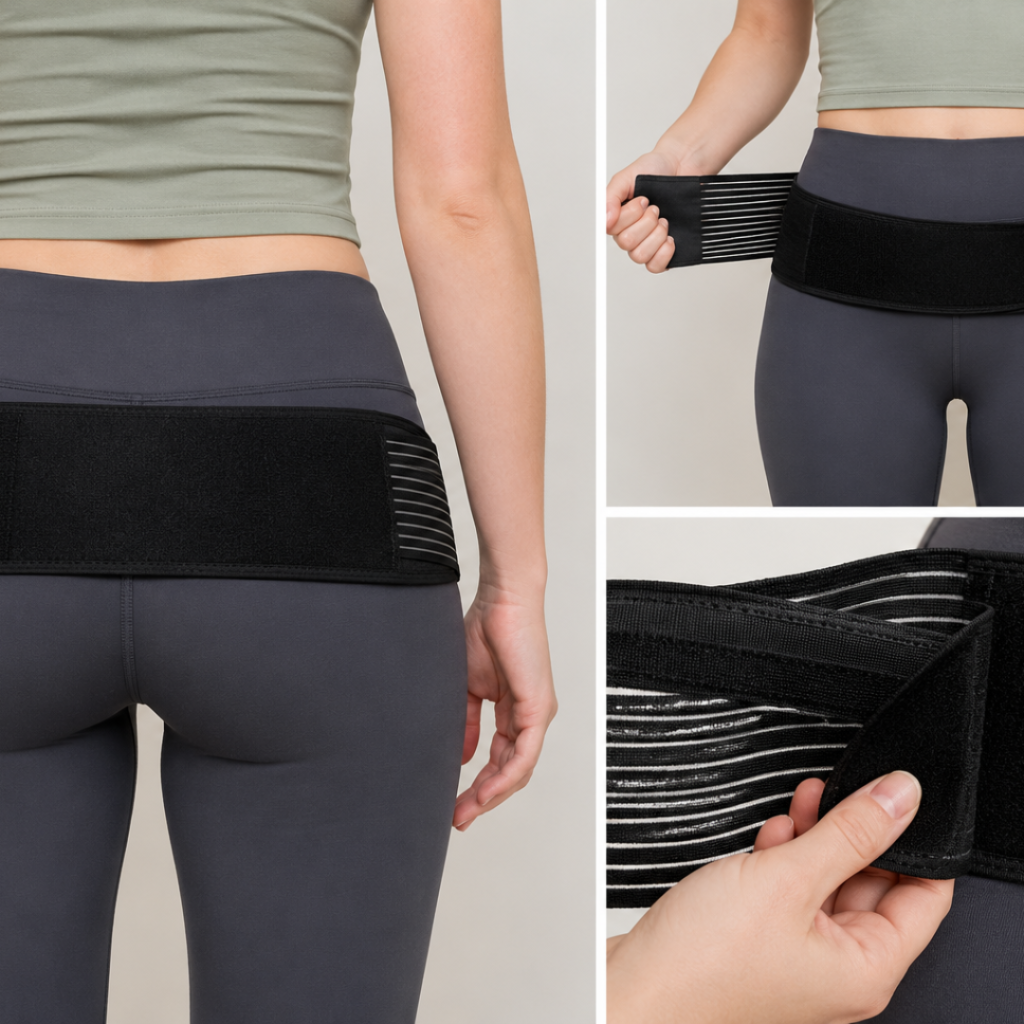
That’s exactly what happened when I came across a hip support belt. My therapist recommended it after seeing how much manual pressure on my hips was already helping during sessions. It’s not marketed for ataxia. It’s built around compression and support through the hips and lower back. But the mechanism is the same one my PT uses by hand: steady pressure on the exact region where my instability starts. It’s helped me a lot, more than I expected from something I didn’t go looking for with ataxia in mind at all.
I’ve also tried a weighted vest a handful of times during PT, a different mechanism entirely (adding sensory feedback through distributed weight rather than compression), and it helped in the moment. But I haven’t used it enough outside a supervised setting to speak to it with the same confidence, so the belt is really the center of this piece, not the vest.
The Part I Keep Wrestling With: Trunk Instability & Support
Here’s where it gets complicated, and where I don’t think there’s a clean answer. The belt helps, clearly and consistently, in a way I can’t really argue with. But some stubborn part of me treats it like a walking stick, or even glasses: useful, undeniably useful, but something I resist leaning on too much because I want to hold onto my own strength for as long as I can. There’s a version of me that worries that reaching for support too readily means giving something up before I actually have to.
My PT disagrees, at least in part. Her argument is that using support like this doesn’t necessarily weaken you faster. It can protect you by reducing the constant, invisible compensation your body does without support, the kind of strain that adds up over the course of a day without you ever noticing. Conserving that energy, she’d argue, might preserve function longer, not shorter. I hear the logic. I’m just not sure I fully believe it yet, or maybe I believe it and haven’t caught up to it emotionally.
I don’t know which of us is right. Maybe neither of us is entirely, or maybe we’re both right depending on the day. What I do know is that ataxia is progressive, and the calculation I’m making today won’t be the one I make in five years. At some point, the choice between using tools like this more and holding onto independence will stop being one I get to make on principle alone. I’m not there yet. But I know it’s coming, and I’d rather be honest about that tension now than pretend I’ve already resolved it.
Why This Distinction Matters for Other People Too
Part of why I wanted to write this is that ataxia is often treated as a single experience, and it isn’t. If your instability starts elsewhere, in the trunk, hips, or core, the standard advice doesn’t always fit. It’s easy to assume nothing’s out there for you specifically, or worse, to assume something’s wrong with how you’re managing it, when really the tools just haven’t been aimed at your version of this.
It reminds me of something I wrote about in Living Without a Finish Line. There’s no clean resolution to any of this, just an ongoing process of paying attention and adjusting as things shift. Trunk instability is its own version of that. It doesn’t always cause a fall. Sometimes it just costs you energy that nobody can see you spending and support that nobody thought to mention. Because it wasn’t built with your version of the condition in mind.
A Few Questions People Ask Me About This
What does it mean for ataxia to “start” somewhere different in the body? It refers to where the instability originates, the trunk and hips versus the limbs or eye movements. Both are ataxia, but they show up differently and respond to different tools.
Why does a hip belt help more than you expected? Because it recreates, externally, the same manual compression my physical therapist applies by hand during exercises, and that specific input seems to matter for how my instability shows up.
Are you worried about becoming dependent on tools like this? Yes, honestly. That tension hasn’t resolved, and I don’t expect it to anytime soon.
Does this replace physical therapy? No. Everything here sits alongside what my PT already has me doing, not instead of it.
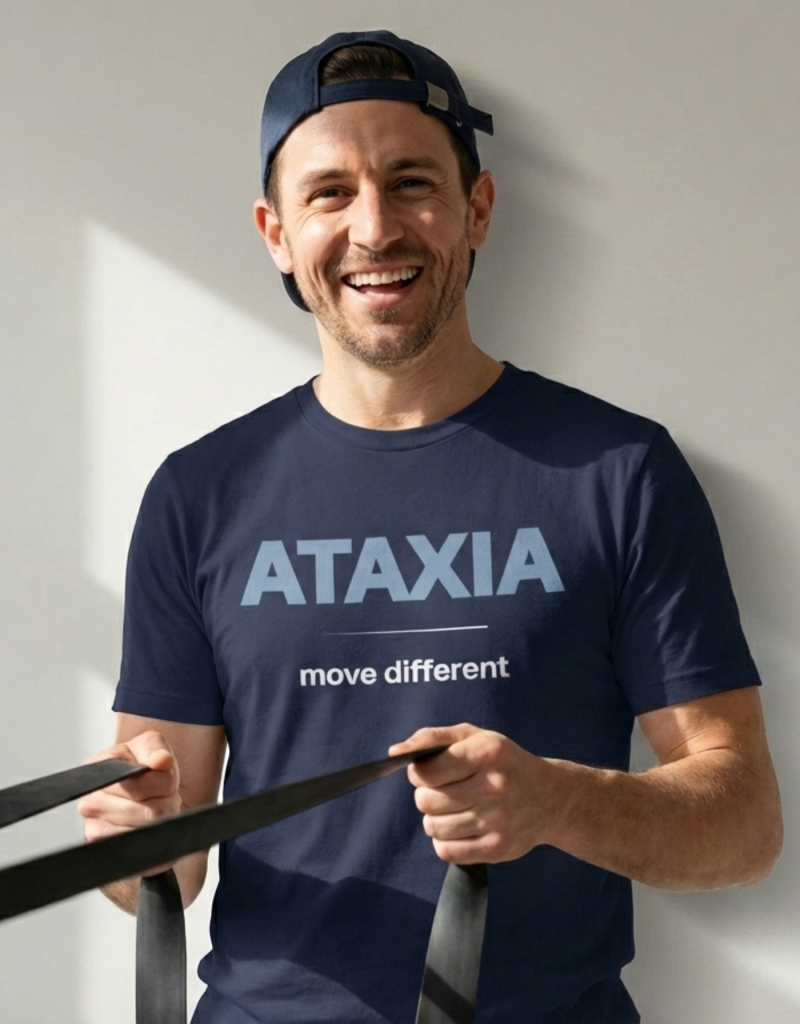
If you’re navigating a version of ataxia that doesn’t match the usual advice, join the community. For more honest, specific reflections like this one. And if you want something that says exactly that, the “Ataxia – Move Different” Tee does the job well. A portion of every sale supports rare disease research.