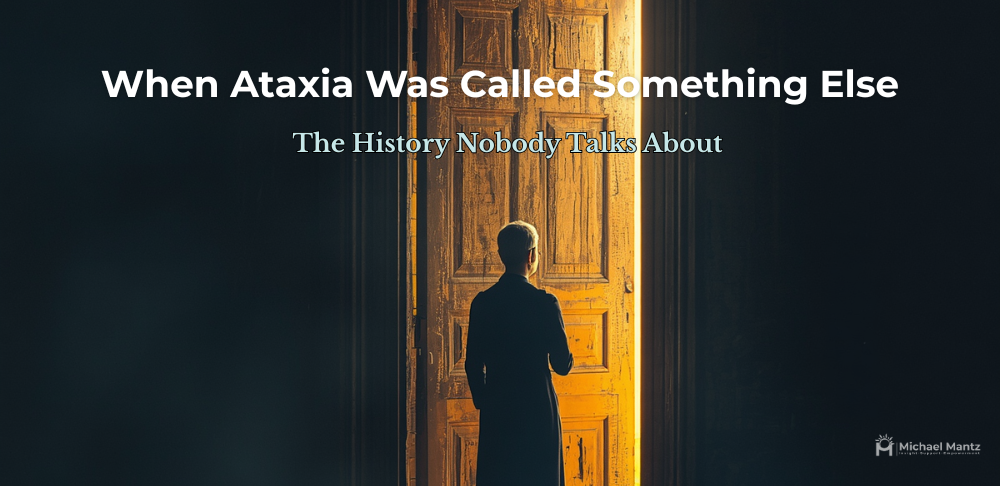
Someone in an online Ataxia group recently asked a question that stopped me mid-scroll. They wanted to know if people with Ataxia symptoms might have been among those accused during the Salem Witch Trials… before anyone understood what was actually happening to them.
It’s a good question. Honestly, it might be one of the best questions I’ve seen in any online patient community.
Here’s the thing: Ataxia, as a diagnosed medical condition, is relatively new. The first hereditary form wasn’t formally described until 1863, when a German physician named Nikolaus Friedreich documented six patients in two families who showed the same constellation of symptoms. Poor balance, unsteady gait, slurred speech, impaired coordination. He gave it a name. Before that, those same symptoms existed. The people experiencing them existed, but the medical framework to explain them did not.
So what happened to them?
The Body Was Doing Something. Nobody Had a Name for It.
Unsteady walking. Slurred speech. Loss of coordination. Tremors. These symptoms are visible, unpredictable, and hard to explain if you don’t know what to look for. To a neighbor, a priest, a magistrate, or anyone without knowledge of neurology, a person stumbling through a marketplace, with words coming out wrong and limbs moving in ways that seemed beyond their control, looked like something other than illness.
It looked like something was wrong with them in an entirely different sense.
This wasn’t a fringe reaction. It was just what people did. When someone behaved in ways nobody could explain, everyone around them seized on the nearest story that made sense. And for most of human history, that story had nothing to do with medicine.
Historians and neurologists have spent considerable time examining what we now recognize as neurological conditions through a historical lens, and the findings are uncomfortable but not surprising. Seizure disorders, tremors, and uncontrolled movements were routinely misread as signs of possession, witchcraft, or divine punishment. A 2025 study presented at the American Academy of Neurology’s annual meeting examined the Salem witch trials and concluded that many of the accused likely had underlying neurological or psychiatric conditions that were beyond the medical understanding of the time. That wasn’t unique to Salem. It played out across cultures and centuries.
When Neurological Symptoms Were Mistaken for Witchcraft
Medieval Europe had a consistent approach to symptoms that didn’t fit known illnesses. Convulsions were demonic. Uncontrolled movement was possession. Speech that came out garbled or fragmented was the devil’s influence. These weren’t personal opinions; they were institutional positions, backed by legal and religious authority.

In 1487, a document called the Malleus Maleficarum, translated as The Hammer of Witches, was published with papal backing and became the standard handbook for identifying and prosecuting witchcraft across Europe. It went through 28 editions between 1486 and 1600 and was used by Catholic and Protestant authorities alike. Scholars estimate that approximately 110,000 witch trials were held in Europe between 1450 and 1750, with roughly half ending in execution. It specifically identified seizures and other bodily symptoms as signs of witchcraft, not as symptoms to be treated, but as evidence to be prosecuted.
Think about what that meant in practice. Someone who lost their footing without warning. Whose speech thickened or slowed. Who appeared, to anyone watching, to have lost control of their own body.
They weren’t patients, but suspects.
The shift came slowly. By the 18th century, physicians began arguing that what appeared to be possession was actually an organic illness. The witch craze wound down not because people became kinder, but because clinical understanding finally caught up. In the 1800s, neurologists like Jean-Martin Charcot began documenting what we now call functional neurological disorders, methodically separating symptom from superstition and giving names to things that had only ever been accused of.
And in 1863, Nikolaus Friedreich put a name to something that had been quietly moving through families for generations without anyone understanding what it was.
What Ataxia Families Lived Through Before a Diagnosis Existed
Hereditary Ataxia doesn’t arrive quietly. It moves through families. Half the children of an affected parent carrying it forward, each generation often hits harder and earlier than the last. That was happening long before anyone had a word for it.
Consider what that looked like from the inside. A father losing his ability to work the farm, his coordination going, his speech changing. Whispers in the community. Then a child showing the same signs a decade later. Then another. No explanation, framework, or language for what was happening except the whispers from everyone around them, which had nothing to do with neurology.
One well-documented family in rural Minnesota was dealing with hereditary Ataxia in the early 1900s, and their community had already begun circulating rumors that the condition might be contagious. Not witchcraft; that era had passed. But the same impulse. Something unexplained is happening. Find a story that fits. As late as 1930, when a family member traveled to a university hospital in Minneapolis, it was the first time anyone had given their condition a name.
Generations of that family had lived and died without ever knowing what was wrong.
That’s not ancient history. It’s less than a hundred years ago.
Why a Rare Disease Diagnosis Changes Everything
It sounds simple but isn’t.
A diagnosis doesn’t just label a condition. It moves it out of the unexplained, where fear lives, and into something with a name and a community behind it. A diagnosis tells a family they are not alone in this and shifts the conversation from what is wrong with this person to what this person needs.
Before Friedreich published his findings in 1863, and before neurologists began building the frameworks we now take for granted, the people living with these symptoms had no access to any of that. They had whatever explanation the world around them offered. For most of human history, those explanations were unkind.
The National Ataxia Foundation exists because that history is still being reversed. There are still people today receiving an Ataxia diagnosis after years of being told something else. Multiple sclerosis. Alcohol dependency. Anxiety. The diagnostic odyssey for rare neurological conditions remains long, even now. The label changed, but the gap hasn’t.
What the History of Ataxia Means for People Living with It Today

People with Ataxia today aren’t accused of witchcraft. But the underlying experience of having a body that reads as wrong to the people around you, triggering assumptions and quick conclusions, hasn’t gone away. It just wears different clothes.
The looks from strangers. The assumptions that you are drunk, impaired, or somehow responsible for the way you move. The doctors who suggest anxiety before they suggest neurology. These are updated versions of the same gap: something unexplained and someone reaching for the nearest available explanation.
The question in that Facebook group was half-joking, maybe. But it pointed to something real. The history of Ataxia isn’t just a medical timeline. It’s a record of how long it takes a society to stop filling in the blanks with fear and start filling them with understanding.
We’re still working on it.
That part, honestly, hasn’t changed much. The misread still happens fast and lands every time, as I wrote in I’m Not Drunk the misread happens quickly. And history just casts a longer shadow. If you want to understand what daily life inside this condition looks like beyond the moments of misidentification, Walking Differently Isn’t the Hard Part covers that.
If this is your first time here, welcome. This blog exists because rare diseases deserve more than medical summaries. If you want to support the community in a tangible way, the InspireThread shop carries apparel designed for people who live with a little more complexity than most.