
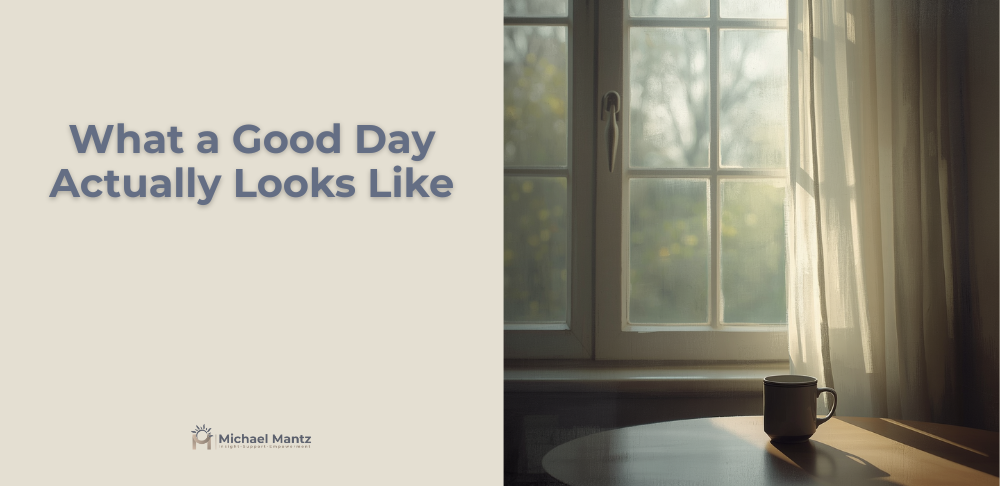
There’s no confetti. No soundtrack and no one shows up at the door to hand you a certificate.
A good day just happens. And if you’re not paying attention, you can miss it entirely.
I’ve been thinking about this lately. What actually makes a day good when your baseline isn’t what most people would consider normal? The definition shifts. It has to. You can’t keep measuring your days against a version of yourself that no longer exists or against what your neighbor’s Tuesday looks like. That’s a losing game. Most people figure that out eventually, whether or not a health condition pushes them toward it.
So what does a good day actually look like?
It Usually Starts Small
Not dramatically and not with some morning routine you read about in a productivity article.

For many of us navigating chronic illness or neurological conditions, a good day starts with something simple. Waking up to your body cooperating just enough. You slept reasonably well. The first few steps across the floor didn’t require negotiation. Coffee got made, you sat down, and it was quiet for a few minutes.
That’s not a low bar. That’s just an honest one.
The small stuff adds up. A good morning sets a tone. Not a guarantee, but a tone. And when you’ve had enough days when the morning goes sideways before it even starts, you learn to notice when it doesn’t. You start paying attention differently. Not in an anxious way, more like someone who’s learned to read the weather.
There’s also something that happens with routine on a good day. Things just flow a little easier. You move through your morning without fighting yourself. It’s subtle, but you notice it. And you remember it.
You Stop Waiting for Perfect
Here’s the thing about a good day. It’s almost never perfect. There’s usually still something. Some symptom that showed up uninvited, some task that took longer than it should, or some moment when you’re reminded that your body has its own agenda.
But a good day doesn’t require the absence of everything. It just requires that the hard stuff doesn’t run the whole show.
Most people outside these conditions don’t realize how much mental energy goes into managing something that never takes days off. The monitoring, the adjusting, the quiet recalibrating that happens constantly in the background. On a good day, that work fades a little. It doesn’t disappear. It just stops being the loudest thing in the room.
That’s worth something. Actually, it’s worth a lot.
I’ve written before about what it feels like when things shift, and your body starts operating in a different register. If you’ve read the piece on life in slow motion, you know that the contrast between a hard day and a decent one isn’t always dramatic. Sometimes it’s just a few degrees of difference. But those degrees matter.
How to Make the Most of a Good Day
A good day is also an opportunity. People who navigate chronic conditions well tend to know this naturally. Not in a hustle-and-grind way. More like: if today is a decent day, use some of it for something that matters to you.
A phone call you’ve been putting off. Getting outside for a while. Working on something creative, or simply being present with someone you care about without half your attention elsewhere.
You don’t have to earn a good day or justify it. But there’s something real about not letting one slip by unnoticed. Not every good day needs to be productive in any measurable way. Sometimes the best use of a decent day is simply enjoying the fact that it’s good. That counts.
The National Ataxia Foundation puts quality of life at the center of its focus, and it makes sense to me. Quality of life isn’t just medical. It’s what happens on ordinary days, the ones that don’t make it into a doctor’s notes.
The Gratitude Trap
One thing worth saying out loud: a good day doesn’t require you to perform gratitude. The Instagram-caption version of chronic illness, where every decent moment becomes a lesson in resilience or a reminder to count your blessings, gets exhausting fast.
You’re allowed to just have a good day without turning it into content. Without finding the lesson in it. Sometimes a good day is just a good day. You made some food, got a few things done, laughed at something, went to bed without dread.
That’s enough. More than enough.
There’s a version of the chronic illness narrative that’s very focused on the hard days, on the struggle, and on what’s been lost. That’s real, and it deserves space. But the quiet good days deserve space too, not as proof of anything, just as part of the full picture.
How Good Days Add Up Over Time
What I’ve noticed, and I think many people in this space eventually notice, is that good days don’t feel significant as they happen. They’re quiet and don’t announce themselves.
But they accumulate. When you look back, the good days are what you hold onto. Not in perfect detail, but as a kind of texture. A sense that things weren’t only hard. That there was more to it than the difficult parts.
That matters more than it sounds like it does, especially during a rough stretch when all you can see (and feel) is the struggle.
I think about this when I look back at some of the harder periods I’ve written about, like the experience with head tremors returning and what that recalibration felt like. The good days during that stretch weren’t dramatic. But they were there. And they added up to something.
What I’d Actually Say
If someone asked me what a good day looks like now, I’d say it looks pretty ordinary from the outside. That’s kind of the point.
It’s a day when I got to do something I wanted to do, when my body cooperated enough that it wasn’t the main character, when I connected with someone, made something, or just moved through the day without it being a fight.
Not every day is that. But there are enough of them that I’ve stopped waiting for something bigger to qualify as good. Last week is a good example of that.
This was my exit PT appointment. I go through a stretch, usually 8 or 10 sessions, then manage on my own for a couple of months before the next round. When I checked in last week, my score was 15. A couple of months ago, it was 12. Amber, my PT, flagged it. I didn’t make a big deal of it in the moment, but I thought about it the rest of the day. That’s what a good stretch looks like for me. Not a cure. Just a 15.
If you’re in a rough stretch right now, I’m not going to tell you to look on the bright side. That’s not what this is. But if today happens to be a decent one, notice it. You don’t have to do anything with it. Just notice.
If any of this resonates, you’re in the right place. Sign up and join the blog community. And if you want to wear something that reflects where you actually are rather than where people assume you are, take a look at InspireThread. There’s something there for the good days and the hard ones.