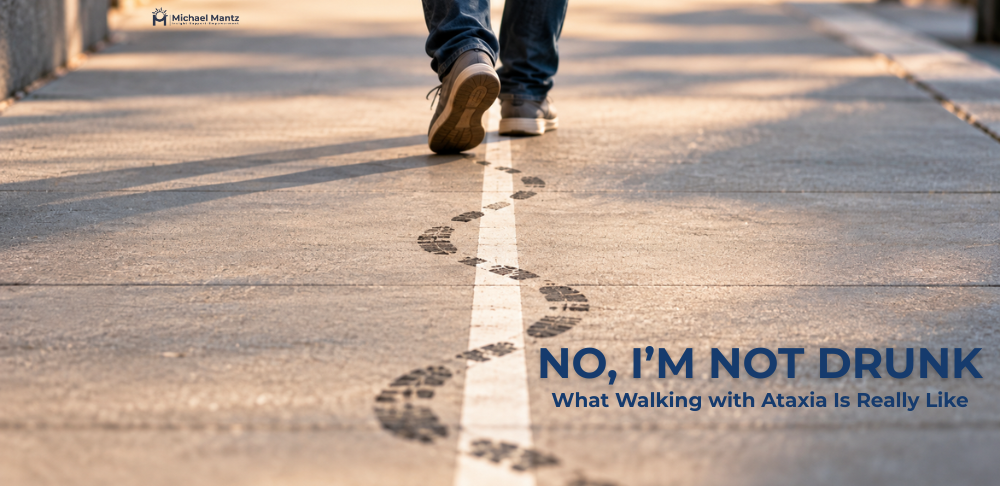
Walking shouldn’t require concentration. Your body should handle it in the background without asking for your opinion.
Mine has follow-up questions.
Not out loud. Nobody ever asks. But I can see it: the look and the recalculation, as they decide that something is going on here and needs an explanation.
So let me help you out. I’m not drunk. (Which I realize is generous information to offer this early.)
Living with ataxia means your walk becomes public information. People notice it before noticing anything else. Some clock it instantly. Others watch a little longer, waiting for the explanation to reveal itself. A few feel confident enough to decide immediately that they know exactly what’s going on, and once they land on that answer, they’re done thinking about it.
That answer is almost always alcohol. People are very comfortable with that one.
Everyone Thinks They’ve Cracked the Code
What I’ve learned is that people love explanations, even bad ones, especially bad ones. As long as it helps them categorize you quickly, accuracy is optional.
Alcohol is comforting and familiar, and it explains everything in one word. It saves time. People don’t want a mystery; they want closure. And nothing gives someone more confidence than assuming they’ve already solved the situation.
I see it happen in real time. There’s a shift. A look. That slight eye or head movement that says, “Oh. This is one of those situations.” Their tone and body language shift. Concern and judgment start to negotiate in the corner.
Nobody says a word. They just let the idea sit there between us.
I’ll be standing perfectly still, having a completely normal interaction, paying with a credit card, forming full sentences, and they’re still thinking, Wow, he’s holding it together pretty well.
At that point, I feel obligated to admit that if I were drunk, this would actually be impressive.
Borderline inspirational.
Walking Is Supposed to Be Automatic. Apparently Not.
Walking is effortless for most people. You go where you’re going and assume your legs will handle it without checking in first. There’s no planning, no review afterward, no moment when you think, Well, that was an interesting choice by my left foot.
That’s not how it works for me.
There’s always some internal navigation going on. I notice the floor, the crowd, and the pace around me. Then comes the math of whether I’m moving too slowly or just slowly enough to look deliberate. My body language has to say “I’ve got this” rather than accidentally say “This could turn into a situation.”
Confidence makes it weirder. Too much, and people get suspicious. Too little, and they hover. Apparently, everyone agrees on an exact amount of confidence, and I never find out what it is in advance!
Some days it probably looks cautious. Other days, it looks like I don’t fully trust the ground yet. Every once in a while, it looks like my legs and I are having a disagreement I’d rather not explain.
None of this feels dramatic on my end. It’s just awareness of something most people never have to consider. I covered the thoughtful side of this in Living in Slow Motion. This is the practical side: when your body doesn’t move the way people expect, everything takes longer, including everyone else’s patience.
The Walking Stick: A Visual Aid for Strangers
I use a walking stick in big crowds, and airports are the best example. People bump into me, the pace changes without warning, and someone always stops dead in the middle of the walkway. The stick gives me one more point of contact with the ground, which helps keep me upright when any of that happens. It doesn’t fix my balance, whatever people assume.
It also tells everyone around me something without a word. People who would have stared or tilted their heads, running through possibilities, see the stick, adjust, and move on. Without it, my walk invites questions. With it, the question gets answered before anyone asks.
I don’t use it in everyday life, at least not yet. Part of that is keeping my own strength. If I lean on it everywhere, I worry I’ll end up needing it everywhere, like glasses. Maybe that changes tomorrow. For now, crowds are where it earns its place.
Does the stick feel like a loss? Sure. It just gets lost inside the bigger one, the one where walking stopped being automatic.
Tripping Is a Social Event Now
Tripping used to be embarrassing. Now it’s just interactive. I don’t remember agreeing to audience participation.
Sometimes it’s barely noticeable. Sometimes it’s big enough that strangers react all at once. There’s always a pause afterward. A collective intake of breath. A silent discussion about whether I need help and who should offer it.
I’ve learned that recovery matters more than the stumble itself. If you stand back up quickly and confidently, people decide it didn’t count. Hesitate too long, and suddenly you’re the main concern for everyone within a thirty-foot radius.
If you’re tripping more than you used to, I wrote about why it keeps happening. It’s rarely dramatic at first, which is exactly why people ignore it.
Sometimes the fall actually hurts. But the audience response usually stings more.
The Best Part: Not Fixing the Room
Ataxia isn’t inspirational. It isn’t poetic or consistent. It’s just there, shaping how my body moves through space.
It has made me observant, though. You notice things when you’re always watching your step. How fast people move. How impatient they get. How uncomfortable they are with unpredictability. You also develop a sense of humor, because without it the absurdity becomes irritating, and irritation is exhausting. At this point, ataxia does most of the crowd work for me.
The older I get, the less interested I am in correcting anyone. I don’t need to reassure them, explain, or make things comfortable. If you think I’m drunk for thirty seconds before realizing otherwise, that’s fine. That’s your journey.
Letting go of that responsibility is where the freedom lives. Ataxia stops being something I manage for other people and becomes something I simply carry. Ironically, that’s when conversations improve, when nobody’s trying to solve anything. I wrote about the heavier side of this when I stopped pretending I was fine, and this is its funnier cousin.
Ataxia and Looking Drunk: Common Questions
Why do people with ataxia look drunk? Most forms of ataxia involve the cerebellum or its connections, the part of the brain that coordinates balance, movement, and the timing of speech. Alcohol impairs the same system, which is why intoxication causes a similar unsteady gait and slurred speech. The appearance is similar, but the cause is completely different. I’m not a doctor, so check with yours for anything specific to your situation.
Does ataxia always affect the way you walk? Not in the same way for everyone. It varies by type and by person. Some people mainly notice balance or walking, while others notice hand coordination, speech, or eye movements. Many experience a mix. It can also change from day to day.
What’s the best way to help someone who looks unsteady? Ask first. A simple “Do you need anything?” works, and most of us will tell you. Everyone with ataxia is different, so the person in front of you is the best source of information.
Stick Around (Pun Fully Intended)
If you laughed, that’s the point. If you didn’t, that’s okay too. People don’t always get me right away. That’s kind of the theme.
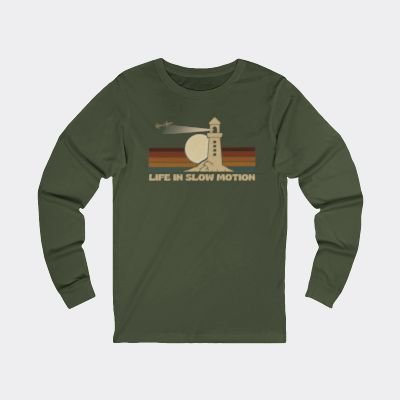
If you want more pieces like this, join the blog community. No lectures. No inspirational cosplay. Just honest, entertaining stories about living a little sideways. And if you like awareness that doesn’t shout for attention, the Life in Slow Motion Long Sleeve Tee fits right in. A portion of every sale supports rare disease research.
I’ll keep walking the way I walk. Unpredictably. Carefully. Occasionally better than expected. You’re welcome to walk with me. Just don’t grab my arm unless I ask. That turns this into a whole different performance.