

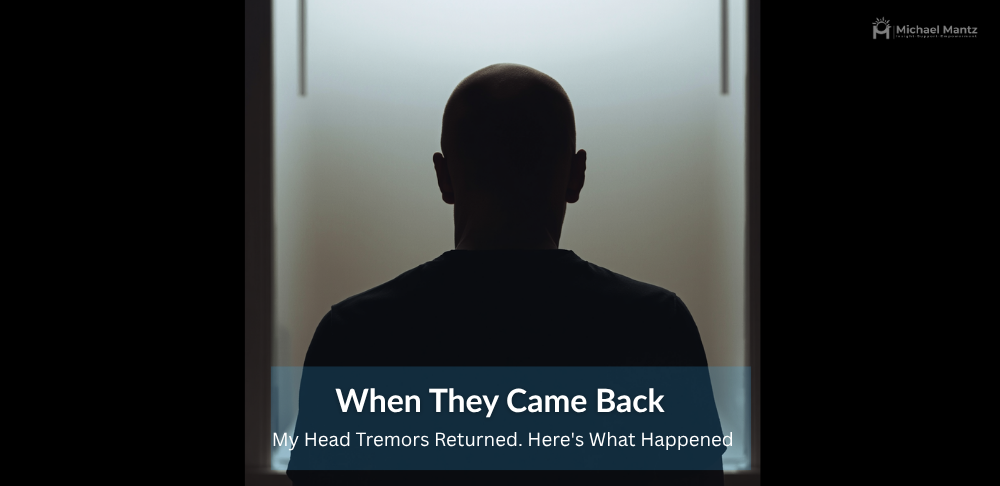
This is Part 2 of my head tremor journey. If you missed the original, you can read it here: Shaking the Silence: My Intense Journey with Head Tremors
Almost three years. That’s how long I had gone without an episode. Long enough to wonder, maybe even quietly hope, that they were done with me.
They weren’t.
The Warning Signs: That Feeling Came Back First
It always starts the same way. Not with the tremors. With something harder to explain.
Imagine a ball of energy sitting in your stomach – light and dense, like a storm compressed into a small space, the kind you’d see in a movie, with smoke and lightning swirling inward. Now picture yourself at the top of a rollercoaster, that split second before the drop, when your body is already bracing for what’s coming. Take that feeling and multiply it. That’s it……..that’s the warning.
Around March 5th, that feeling was back.
I know the pattern well enough now. First, there’s the stomach energy – a week or so of that tight, full-body anxiety that signals something is shifting. Then come mild tremors. After that, the worst part usually hits around the third week, when I genuinely can’t do much. No reading, no screens, no real focus. Just lying down and getting through it. By the fourth week, things start to ease up. The energy ball gradually settles, and eventually, it’s over.
I know this because I’ve lived it for fifteen years.
So when that feeling returned in early March, I thought maybe I could outrun it. Sleep more. Stay calm. Do as little as possible. Maybe it wouldn’t turn into tremors this time.
I should have known better.
The Drive That Changed Everything
A week into that stomach energy, I could feel the pattern holding. The ball was moving up. I decided to go to the gym; nothing intense, just trying to burn off some of it. Light movement. It went okay. Afterward, I grabbed a quick lunch and headed home.
Westbound on the highway. Two or three blocks from my house.
It happened fast. That ball of energy exploded upward. Like a volcano letting go all at once, and the tremors hit harder than they ever had. I remember the sensation of my jaw lagging behind my head, not keeping pace with the force of the movement. The “no-no” motion, violent now, my upper body following. And all around me: a white car in the turn lane on my left, a white semi on my right.

I couldn’t see the road.
Having no choice but to pull into the open median, hazards on, and just breathe. I called around, trying to find someone to come pick me up and drive my car the two blocks home. No luck. So after a few minutes, I looked for a gap in traffic, held my head with my left hand (which honestly did almost nothing), and drove home as slowly as I could manage.
My car has been parked since then.
Three Weeks Homebound: Life During a Tremor Episode

What followed was three weeks mainly spent indoors. The only times I went out were when a friend or family member picked me up, not to go anywhere specific, just to get outside for a few minutes. Rides to medical appointments, neurofeedback, acupuncture, and a mild anxiety medication my neurologist prescribed to help with the body anxiety that goes along with the tremors.
Did any of it help? Did all of it help? I honestly don’t know. I just wasn’t going to sit there passively.
During that time, I did some digging. Three years had passed since my last episode, and I wanted to see if anything new had come up. One discovery gave me a clinical name for what I experience: titubation. Specifically, the horizontal ‘no-no’ head tremor originates from cerebellar dysfunction. A recognized symptom of cerebellar ataxia is described as rhythmic oscillations of the head and trunk. Somehow, giving it a name, a precise clinical term, felt significant. Not a solution, just clarity.
The Fear Underneath Every Episode
Here’s the thing I don’t talk about enough. Every single episode carries the same quiet dread underneath it.
Yes, I have a fifteen-year history of these always going away. Every time, they’ve left. That track record means something. But this is a progressive condition. And somewhere in the back of my mind, every time the tremors are at their worst, is the same thought: maybe this time they don’t leave.
That thought doesn’t get quieter with time. If anything, it gets sharper.
As I write this, I’m on the other side of it or close enough. The past few days have only brought a few mild tremors, lasting about thirty seconds each. The storm is calming down. I plan to get back to the gym this week, restart my home balance exercises, and eventually get behind the wheel again. All of it comes with its own anxiety, but I’ll get through it. I always do.
But something feels different this time. Not medically; the pattern stayed the same. What’s different is what I’m thinking about on the other side of it.
On the Other Side…..And What Comes Next
I’ve always tried to stay positive. To share what I’m going through, raise awareness, and contribute something useful to the ataxia and rare-disease community. I believe in that work, and I’ll keep doing it.
I’ll be honest, and this is something I’m still figuring out. I think I’ve taken a somewhat safe approach. Not reckless safety, but cautious in ways that might go beyond what the condition actually requires. Life is too short for that. Having a progressive condition already changes many things. An experience like this – its intensity, the isolation, the driving scene I’ll never forget – adds a whole new layer to it.
I don’t yet know exactly what the changes are. But I know something has to.
If you’re living with something similar, like tremors, a movement disorder, or anything that takes over your body without warning, you already know this isn’t just a medical story. It encompasses everything around it – the waiting, the isolation, the negotiations you have with yourself, and the fear masked as patience.
You’re not alone in that. Not even close.
If this resonated with you, I’d love for you to join the community at michaelmantz.com. And if you’re looking for a way to carry something forward (a reminder of resilience on hard days), check out InspireThread, where every purchase supports ataxia/rare disease awareness and research.










The head tremors sound scary and awful. Thank you for writing about your Ataxia experience. It helps.
I just started seeing a Speech Language Pathologist funded by public health 🇨🇦.
She advised a novel approach to my concerns that my voice has changed due to Ataxia and sounds raspy. In addition to vocal exercises, she suggested voice banking. That’s where a person gives AI, archival copies of their voice. Then through a complex process, the AI reproduces their speech.
I’ve begun the lengthy process. I envision using my AI voice for pre-taped podcasts. We’ll see if it works! Right now podcasts are off my list and that’s a shame. I have lots of activist ideas left!