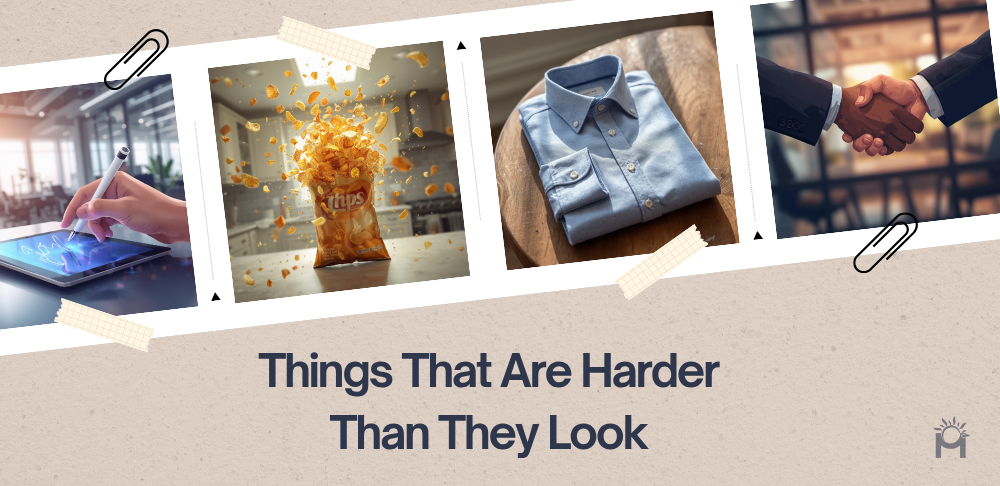
Nobody tells you about this part. You just show up one day and find out that opening a bag of chips in public is, apparently, a skill you have to earn.
Ataxia has a way of introducing you to the physical world at a level of detail most people never need. I now have opinions about door handles, parking lots, and the specific cruelty of the touchscreen signature. What follows is a field guide. It is based entirely on firsthand experience, mostly in situations I did not expect to find educational.
The Chip Bag
The chip bag requires two hands working in opposite directions, a decent grip, and some faith that the seal will give way gradually. None of that is guaranteed. What tends to happen instead is a long stretch of quiet effort, followed by chips going everywhere at once, followed by a moment of silence where you and the bag just look at each other.
The chips that land on the floor are gone. The ones that land on the couch take a few minutes to locate. The bag itself looks completely unbothered by the whole thing.
I buy resealable bags now. It’s not really a preference. It’s just what happens when you lose enough arguments with a snack.
The Touchscreen Signature
At some point, someone decided that dragging a small stylus across a two-inch glossy screen was a reasonable substitute for a signature. That person has never had a tremor.
My touchscreen signature looks less like a name and more like a seismograph reading from a geologically active region. I’ve watched cashiers look at the screen, then at me, then back at the screen, and then quietly move on without a word. I respect that decision more than I can express.
Occasionally someone says “just do your best.” I am. That is my best. The seismograph is the signature now.
The Handshake
The handshake looks simple because for most people it is. Two hands meet, grip briefly, then release. The whole thing takes about a second, and nobody thinks about it again.
Mine occasionally involve a small timing delay, a grip that lands slightly off-center, or a release that one person interprets as finished while the other is still holding on. This creates a brief, wordless negotiation about whether we are still shaking hands or whether that part is over. It usually resolves itself. It is never the unremarkable social exchange it is supposed to be.
I’ve gotten better at the pivot to the forearm clasp when the standard version starts going sideways. It reads as warm and intentional. It is neither of those things. It is a recovery move, and it works about eighty percent of the time.
The Parking Lot
The parking lot is not a single thing. It is a collection of surfaces, slopes, lighting conditions, and hidden surprises that vary significantly by location, season, and the property manager’s budget decisions for that year.
I have strong opinions about every parking lot I’ve visited more than twice. I know which ones have a slope near the entrance that looks flat but isn’t. I know which ones have a patch of loose gravel that appears without warning near the back row. I know which cart corrals are positioned so they’re useful for more than just carts.
This isn’t the kind of local knowledge most people accumulate. It turns out to be surprisingly useful. I’m basically a parking-lot sommelier at this point, except instead of recommending wines, I’m telling you which Costco entrance is worth the extra thirty feet.
The Button Down
There is a spectrum of buttons. At one end is the large coat button, which is mostly decorative and takes almost no effort. At the other end is the small button-down shirt button, which requires you to pinch two pieces of fabric together through a hole the size of a chickpea, hold that grip long enough to finish the job, and repeat the process six or seven times in a row before you can leave the house.
I allow extra time for button-downs. I’m not going to say how much, because I think the number would surprise people, and it varies depending on the day, the shirt, and how cooperative my hands feel about the whole project.
What I will say is that I now have a very clear opinion about which shirts are worth the effort and which ones aren’t. Some mornings the answer is neither, and I find a third option.
The Zipper
The zipper has one job. It does that job when the insert goes in at exactly the right angle, which it finds on its own schedule, not yours.
This applies to jackets, hoodies, gym bags, and anything else with a separating zipper. It applies in January, when your hands are cold, and in July, when they aren’t. The zipper doesn’t care about the weather or how many people are standing around waiting for you.
I have stood in a parking lot long enough for the person I was with to offer help, which I declined. They offered again, which I declined as well. We both just stood there, pretending everything was normal, until the zipper decided it was ready. This has happened more than once. It will probably happen again.
There is no real solution here. You just get faster at looking like you meant to take that long.
A Note on All of the Above
None of this is exclusive to Ataxia. Anyone who has tried to open a ketchup packet with cold hands, sign a credit card screen with a stylus the width of a pencil, or zip a jacket while holding groceries knows that the world is full of tasks designed for conditions that don’t always exist.
The difference is frequency. Most people run into these moments occasionally. I run into them on Tuesday and again on Wednesday. By Thursday, I’ve usually got a few more to add to the list.
What I’ve figured out over time is that the tasks that look simple are rarely the ones that are. The world is full of small, invisible difficulties that most people walk right past because they’ve never had a reason to notice them. What You Don’t See About Living with Ataxia gets into that gap more seriously if you want the version without chips.
In the meantime, I’ll be in the parking lot I’ve already scoped out, eating snacks from a resealable bag, and signing things with what is technically a signature.
FAQ
Why do everyday tasks feel so much harder with a neurological condition like Ataxia? – Many routine tasks require fine motor control, grip strength, coordination, or balance that neurological conditions can affect in ways that aren’t always visible from the outside. Tasks that look effortless to most people can involve a significant amount of physical coordination that simply doesn’t work the same way.
Are there tools or adaptations that help with fine motor tasks? – Yes. Magnetic closures, resealable packaging, larger-grip utensils, and button hooks are all practical options. An occupational therapist can help identify solutions tailored to your specific situation. The Etiquette Nobody Wrote for Walking Slowly in a Fast World covers a related set of public-space adaptations if you’re curious.
Is humor a helpful way to cope with chronic illness? – For a lot of people, yes. It doesn’t make the hard parts easier, but finding the absurdity in a zipper standoff at ten below tends to make it slightly less frustrating while you wait for it to resolve itself.
If this made you smile, there’s more at the community page, with new articles as they come out. And if you want to wear something that matches the energy, the Life in Slow Motion tee at InspireThread says it without needing eleven paragraphs to get there.