



This is part of the Resilient Voices series — honest stories and perspectives on living with Ataxia and beyond.
I’ve seen versions of this message shared before—lists that begin with, “I don’t look sick, but…” They always hit a nerve. Some of the experiences listed in that viral image—I’ve lived them. Others, I haven’t. I have a milder form of Ataxia—SCA15—which means my symptoms are often less visible than what others in our community face.
But that’s the thing about Ataxia—and rare conditions in general: no two stories are the same. Some of what’s mentioned here may resonate deeply with you. Some may not. That doesn’t make any of it less real or less worth saying. This post isn’t just about me—it’s about the many experiences I’ve had, read about, or seen reflected in the stories of others. It’s a snapshot of our broader community, inspired by an image that’s been making the rounds again.
These aren’t complaints. They’re glimpses. By putting them into words, I hope to help people understand the daily reality so many of us quietly navigate.
Because looking fine has nothing to do with feeling fine, sometimes, looking fine means I’ve gotten good at hiding what hurts.
Ataxia doesn’t leave visible bruises. It doesn’t come with a wheelchair, a bandage, or a cast—at least not in the early stages. It comes with instability, exhaustion, misfires between brain and body, and a thousand tiny adaptations I make to move through the world without drawing attention.
When I saw the image “I Don’t Look Sick” making the rounds again, I paused. Not because it was new, but because every line echoed something real.
Let’s break it down. Not with butterflies or soft filters. Just with honesty.
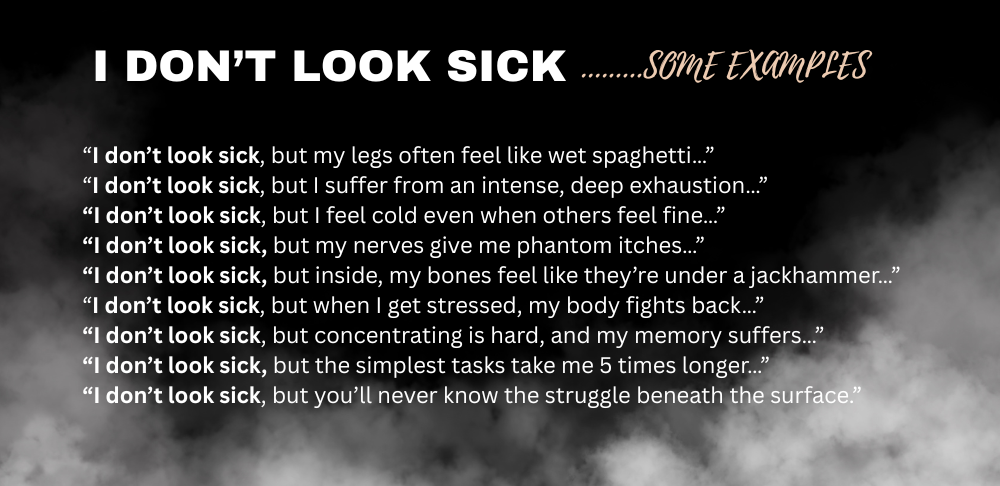
“I don’t look sick, but my legs often feel like wet spaghetti…”
Balance and coordination don’t always show on the outside. I’ve walked into rooms upright and left wondering how I didn’t collapse. Some days, my legs cooperate, and some days, they don’t. It’s not consistent, which makes it even harder for others to understand—or believe.
There’s no outward cue, no blinking light that says, “This is a hard day.” So, I keep walking. Sometimes wobbling. Often hoping no one notices.
“I don’t look sick, but I suffer from an intense, deep exhaustion…”
This isn’t just “tired.” This is underwater tired. It’s trying to move through a day like swimming through molasses. It’s sitting down to rest and realizing hours have passed, and your body still hasn’t recovered.
And yet—I’ve learned to smile through it. Because if I don’t, I have to explain it. And explaining
invisible things to people who’ve never lived it? That’s its own kind of exhaustion.
“I don’t look sick, but I feel cold even when others feel fine…”
For me, it’s not heat intolerance—it’s the opposite. I’m often colder than everyone around me. A room that feels comfortable to others might feel chilly to me. And while it may not sound like a big deal, it adds up. I’ve learned to dress in layers, carry an extra hoodie, and constantly adjust my surroundings just to feel steady.
It’s another invisible layer—something no one sees, but I navigate every day.
“I don’t look sick, but my nerves give me phantom itches…”
It’s strange what you get used to. Nerve misfires, odd sensations, sudden jolts. Sometimes it feels like an itch you can’t reach, like your skin is betraying you. Other times, it’s a full-body static you can’t shut off.
And when you try to describe it, words fall short. How do you explain something that doesn’t exist physically, but is constant internally?
“I don’t look sick, but inside, my bones feel like they’re under a jackhammer…”
Pain comes and goes like weather fronts—sometimes triggered by actual weather. Other times by stress, movement, or nothing at all. It’s not always sharp. Sometimes it’s dull and dragging. But it lingers.
And because you’re upright, dressed, and maybe even smiling, people assume you’re okay. That disconnect? It can be isolating.
“I don’t look sick, but when I get stressed, my body fights back…”
This is one of the hardest truths to explain: how mental and emotional stress becomes physical, how even minor worry can spark symptoms—slurred speech, shaky hands, fatigue, and dizziness.
People say, “Don’t stress,” as if that’s helpful. But when you live with Ataxia, stress isn’t just a feeling. It’s a trigger. It’s a flare-up waiting to happen.
“I don’t look sick, but concentrating is hard, and my memory suffers…”
Brain fog. It’s real. I can be mid-sentence and lose the thread. I can forget names I’ve said a thousand times. And when you’re someone who prides themselves on being sharp, that kind of fog feels like failure.
It’s not. But it feels like it, especially when no one sees it happening.
“I don’t look sick, but the simplest tasks take me 5 times longer…”
Getting dressed. Making a meal. Typing this blog post. Everything takes more time and more energy than it should. There’s nothing “simple” about simple tasks when your body doesn’t respond the way you expect.
You learn to build in a margin. You learn to say no, even when you want to say yes. You learn to live slower—not because you want to, but because you have to.
“I don’t look sick, but you’ll never know the struggle beneath the surface.”
And maybe that’s the hardest part.
Because I don’t look sick, people assume I’m exaggerating. Or too sensitive. Or inconsistent. Or lazy. But what they’re really seeing is adaptation—years of micro-adjustments, of masking, of resilience.
I’ve learned to carry this silently. But silence doesn’t mean absence. And just because someone looks okay doesn’t mean they are.
Final Reflection:
So, if you know someone with Ataxia—or any invisible condition—try this: believe them. Even when you can’t see it. Even when they seem “fine.” Especially then.
Trust that what they’re sharing is real. Offer support without needing a visible cue. Let them set the pace. Let them take up space.
And if you’re the one living it—if you’re the one silently carrying the weight—know this:
You don’t have to prove your pain. You don’t have to perform your illness. You don’t need permission to be honest about your experience.
You may not look sick. But that doesn’t make your story any less true. And the people who really get it? They’ll see you, not just your surface.
If this resonates with you, I’d love to hear your story. Share your thoughts or comment below. And if you’d like to get involved and share your experience with Ataxia, reach out.
Join our community—a space for honesty, connection, and overdue awareness. A place where your voice can inspire change, and your experience has the power to uplift others. Because together, we’re not just raising awareness—we’re building understanding.










Thanks Michael for this blog post. Many times I catch myself on a phone call responding cheerily to the caller that “I’m fine.”
And in many ways, I am. Except when my legs quiver and shake, or when I shuffle rather than step, or when I surf on furniture to get to other side of the room (where I left my cane). It takes the resiliency of a cockroach to manage Ataxia! That makes me smile.
We’re being stomped on and yet surviving. Looking kinda okay. I’m glad you’re raising awareness about Ataxia.
Thanks Franke!