
Part of the Living Rare series — stories and reflections on the strength it takes to show up in everyday life.
You probably don’t think twice about putting on socks. Most people don’t. But for those of us living with Ataxia—or similar neurological conditions—it’s the kind of task that can test your coordination, balance, patience, and heart, all in a single moment.
In her raw and beautifully written blog post, “Grateful to Put on Socks,” Lily Pierce puts words to something many of us feel but rarely explain. She lives with Friedreich’s Ataxia, a progressive condition that affects movement, speech, energy, and—uniquely—often the heart. In this short reflection, she walks us through one very real, very human win: putting on both socks without asking for help.
It’s not about proving anything. It’s about what it takes to do something that used to be automatic.
The Stretch, The Breath, The Heartbeat
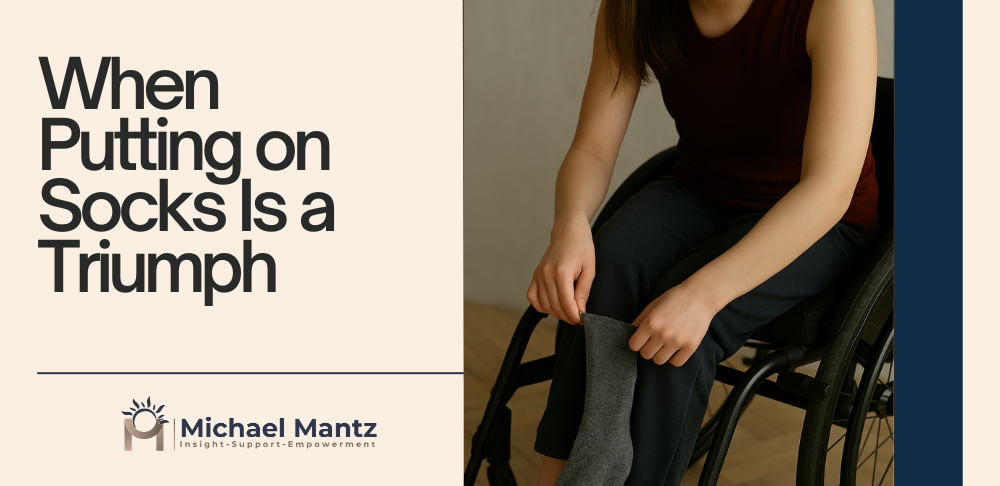
Lily starts by describing how she steadies her feet on her wheelchair’s footrests, then bends to reach her sock. Her chin ends up on her shin. She’s straining, losing her center of gravity, and fighting to hold position, not to show off, but to cover her right foot. Afterward, she sits up, breathes, and lets her heart slow down.
That’s where the honesty hits: for many with Friedreich’s Ataxia, cardiomyopathy (a weakening or thickening of the heart) is a very real concern. And that’s not a symptom you can push through. It’s not just uncomfortable—it’s dangerous.
Reading that part, I nodded. Because I know what it’s like when something so basic suddenly feels like an event. I’ve had moments where I was standing too long, reaching too far, or getting dressed turns into a whole scene—tension, imbalance, fatigue, and the lingering question of
“Should I even be doing this?”
And yet… we try because these little moments matter.
It’s Not Pretty—But It’s Powerful
Lily doesn’t sugarcoat anything. She tries a new method for her left foot, lifting and crossing it over her other knee to get better access. It’s awkward. Unstable. Not elegant. But it works. And when both socks are on, she celebrates the quiet relief—her frozen feet warming up, her body no longer fighting the cold, her sense of autonomy intact.
This is the kind of win that doesn’t make headlines. But in the world of Ataxia, it’s big. There’s something powerful in saying, “I did this. I didn’t have to ask today.” Not because help is bad—we all need it—but because independence feels different when you’ve had to give pieces of it away slowly.
And sometimes, socks are symbolic. They’re a quiet “I’ve got this,” even when so much else feels out of your control.
What We Think We Can’t Handle—We Often Can
One of the most powerful shifts in Lily’s writing comes when she reflects on her younger self, when using a wheelchair felt like the worst possible fate. But now? She’s over that. In her words: “You can be pretty and funny and sit courtside at basketball games and take pictures in front of waterfalls—even in a chair.”
That line stuck with me because I’ve felt that internal evolution, too. What I once feared as “the end” turned out to be something I could live with, grow inside of, and even find new forms of joy through.
It doesn’t mean the journey is easy. But it does mean that our younger assumptions about what life “should” look like often crumble when we realize what life still can be.
Half Full, Half Empty—or Something Else Entirely
Lily closes her piece with reflections on where she is now—on SkyClarys, the first FDA-approved treatment for FA, healing from an ankle injury, biking short distances, and managing back pain. But the heart of it is her mindset. And I think it’s a question we all face in this community:
Do we count the blessings or the losses?
Do we resent the help or honor those who show up for us?
Do we focus on the progress or the pain?
Every moment, we choose what lens we’ll use. And it’s not always easy. Sometimes I’ve focused on the wrong thing for weeks—or months—before snapping back to what matters.
Lily doesn’t pretend she has it all figured out. She doesn’t deny the pain or the reality of what FA takes. But she ends with a choice that resonates deeply:
“Do I feel sorry for myself and let bitterness eat me alive, or feel JOYFUL because I am still alive, and there is so much to live for?”
That hit me. Because even on my harder days—when symptoms flare, when tremors return, when the mental load is just too much—I still believe there’s something to live for. Sometimes it’s just a moment of laughter. Or a walk. Or putting on your socks by yourself.
Why These Stories Matter
You might be wondering—why write a whole post about someone else’s socks?
This isn’t just about socks; it’s about what it means to show up for yourself every day, even when your body doesn’t cooperate. It’s about finding meaning in the moments other people overlook. And it’s about building a space where we can share our realities, without trying to impress or needing to hide.
So, thank you, Lily, for reminding me—and all of us—that strength doesn’t always look bold. Sometimes it seems like sitting in a chair, steadying your breath, and finding a new way to finish the job.
And to anyone reading this who’s been there, you’re not alone. These small victories? They count.
If this spoke to you, I’d love to hear your story. Leave a comment, send me a note, or join the growing community. We’re building awareness, one real conversation at a time.


Hi. I am Lily’s Mom. Even though I had read her article, your commentary on it brought tears to my eyes. The things that we all take for granted everyday CAN be a major accomplishment for someone else.
Just wanted to say “Thank You” for sharing this. As I tell Lily, everyone has their struggles and their weaknesses. Hers are seen, while many others wrestle with internal issues and demons which are even worse than FA.
God bless you, Michael, as you raise awareness.
I hope you have WONDERFUL day!
Rynn McGee -Pierce
Hi Rynn,
Wow, thank you. I honestly wasn’t expecting a message like this. Lily’s words hit me, and I thought it was an excellent reminder for everyone! You’re right—what we often take for granted can be someone else’s big win. And that reminder is powerful. So many people are going through things we’ll never see, and I think that’s precisely why awareness and empathy matter so much.
Please tell Lily her story makes an impact. I was honored to help share it.
– Mike
Congrats Lily and Michael! I shared the article on social media with this wisdom from Lily: “Do I feel sorry for myself and let bitterness eat me alive, or feel JOYFUL because I am still alive, and there is so much to live for?”
Keep up the good work!
Exactly, and thank you for the share!