

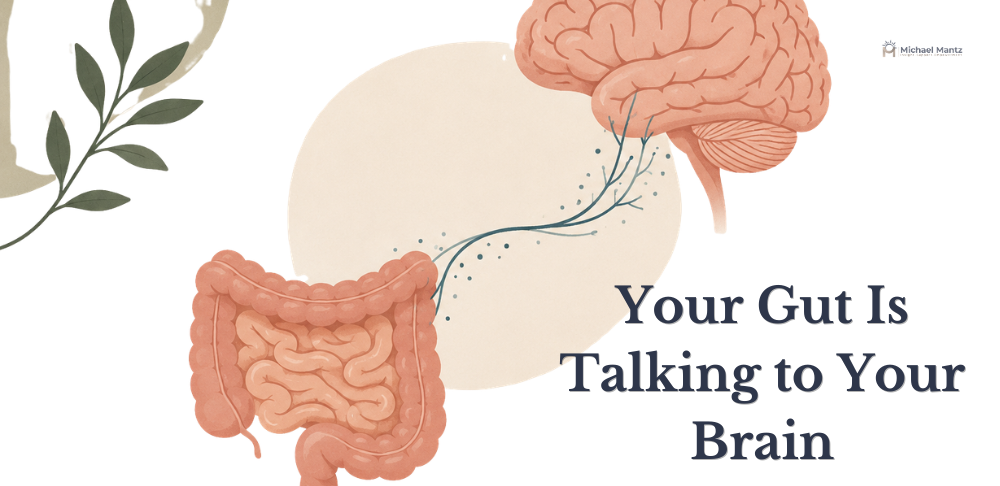
Most people think of their gut as a digestive system. Something that processes food, causes problems when you eat the wrong thing, and doesn’t have much to do with anything happening north of your stomach. That turns out to be significantly wrong.
Your gut and your brain are in constant two-way communication, sending signals back and forth through a dedicated nerve, a dense web of chemical messengers, and a community of trillions of microorganisms that has a measurable influence on how your brain functions. This isn’t fringe science. It’s one of the more actively researched areas in neurology right now, and the findings are specific enough to warrant attention if you have any nervous system condition.
I’ve been paying attention to it for a while, partly because the research keeps getting harder to ignore, and partly because when you already have a neurological condition, such as spinocerebellar ataxia, the idea that something as basic as what’s living in your gut might influence how your nervous system functions is either alarming or interesting. I’ve decided to treat it as interesting.
*This article is for informational purposes only and does not constitute medical advice. If you have questions about gut health, diet, or your neurological condition, consult a qualified healthcare provider.
What the Gut-Brain Axis Actually Is
The gut-brain axis is a bidirectional communication network connecting your gastrointestinal tract and your central nervous system. The primary physical connection is the vagus nerve, a long nerve that runs from your brainstem down to your colon. Think of it as a direct phone line. Your brain sends signals down to regulate digestion, motility, and gut function. Your gut sends signals back up to the brain about what’s happening below the neck, including information that influences mood, inflammation, stress response, and neurological function.
The gut also has its own nervous system, sometimes called the enteric nervous system, which contains about 500 million neurons. That’s more neural tissue than your spinal cord has. It can operate independently of the brain, which is why your gut seems to have a mind of its own when you’re anxious or under stress, and why stress reliably disrupts digestion. The two systems talk to each other constantly, not just in one direction.
Then there’s the microbiome, which adds another layer. The trillions of bacteria, fungi, and other microorganisms that live primarily in your intestines aren’t just along for the ride. They produce chemical signals, including neurotransmitters, that influence brain function. Roughly 90 percent of your body’s serotonin is produced in the gut, not the brain, and your gut microbiome directly regulates how much is made. The implications of that single fact are still being worked out.
Why This Matters More If You Have a Neurological Condition
A 2026 study in Frontiers in Aging Neuroscience found that microbiome health consistently appears in research on neurodegenerative conditions, including Alzheimer’s, Parkinson’s, MS, and ALS. The researchers stopped short of saying the gut causes these conditions, which is the right call at this stage. What they’re saying is that the connection keeps appearing across enough different studies and enough different conditions that it’s worth taking seriously.
For anyone with a nervous system condition, such as ataxia, the gut-brain connection is worth considering for a specific reason. Chronic inflammation in the nervous system is a feature of many neurological conditions, and your gut microbiome is one of the main places your immune system gets its cues. When the microbiome is disrupted, immune regulation tends to follow. That doesn’t fix anything on its own, but it’s a real mechanism, and knowing it exists is useful.
There’s another piece worth knowing. When gut bacteria break down dietary fiber, they produce compounds that help protect the barrier between your bloodstream and your brain. That barrier matters because what gets through it influences neurological health. Whether your gut is producing enough of the right things to support that process depends largely on what you’re feeding it.
What Disrupts the Microbiome
Before getting to what supports the microbiome, it’s worth being clear about what disrupts it, because several of the biggest disruptors are common and sometimes unavoidable.
Antibiotics are the most significant factor. They’re sometimes necessary, but they don’t discriminate between harmful bacteria and the beneficial strains you’ve been building up. Recovery of microbiome diversity after a course of antibiotics can take six to twelve months, and some species may not fully return without active dietary support. This doesn’t mean avoiding antibiotics when you need them, but it does mean being deliberate about rebuilding afterward.
Highly processed foods, foods high in refined sugar, and low-fiber diets all reduce microbial diversity over time. Chronic stress affects the microbiome through the same gut-brain pathway – stress signals travel down the vagus nerve, disrupting both gut function and the community of microbes living there. Poor sleep, already a challenge for many people with neurological conditions, affects the microbiome by disrupting your body clock.
None of these are fully within anyone’s control, especially when you’re already managing a condition that makes sleep and stress harder to regulate. But knowing what the disruptors are means you can at least make deliberate choices in the areas where you do have some control.
What Actually Supports It
Research on this is more consistent than you might expect. What you eat matters more than any supplement you could take. Probiotics help, but without dietary fiber to feed them, they don’t stick around long. Think of it this way: probiotics are the seeds, and fiber is the soil. The seeds need the right environment to take hold.
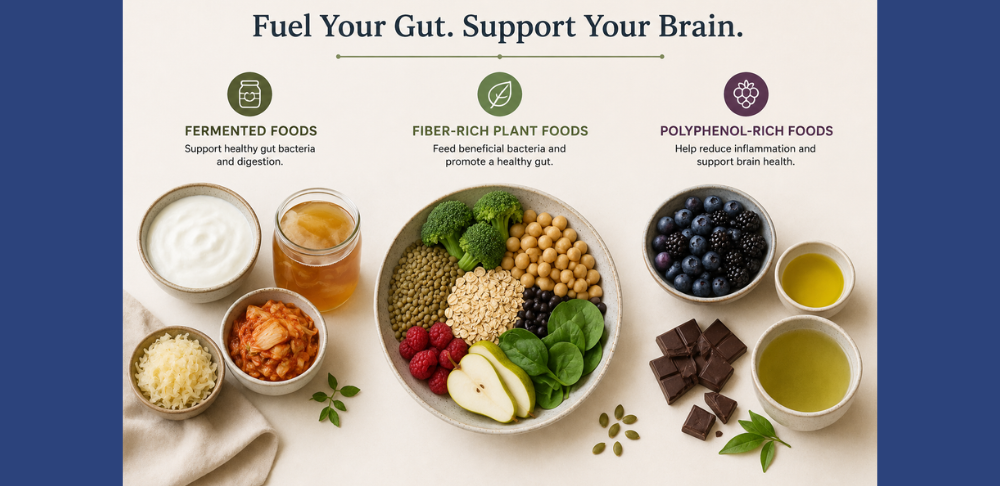
Fiber is the most important single factor. A wide variety of plant foods – vegetables, legumes, whole grains, nuts, seeds, and fruit – supports the microbial diversity your nervous system benefits from. Variety is the key word here. Different types of fiber feed different bacterial strains, so the more variety in your diet, the more variety in your gut.
Fermented foods like yogurt, kefir, kimchi, sauerkraut, miso, and kombucha introduce live bacterial cultures directly. They are backed by solid research showing they increase gut diversity and reduce inflammation. The catch is that occasional additions don’t do much. It works better when fermented foods are part of a consistent routine, not just when you remember to buy kimchi.
Berries, dark chocolate, olive oil, green tea, and colorful vegetables feed the beneficial bacteria and discourage the strains you don’t want. The Mediterranean diet, which leans heavily on these foods, has the most consistent research support for both gut health and neurological outcomes among all dietary approaches studied so far.
On supplements: probiotics are worth it after antibiotics or during a stretch when your gut is clearly off. Otherwise, consistently getting fiber and fermented foods will do more than a supplement and is cheaper.
What the Research Can and Can’t Tell You
Gut-brain axis research is genuinely exciting and still developing. Most studies on neurological conditions show connections, not proven causes. The field is moving fast, and the practical recommendations. Eat more fiber, more fermented foods, cut back on processed foods, manage stress where you can – aren’t new. What’s new is a clearer picture of why these things matter at a neurological level, not just a general health one.
I’m not in the business of telling people that food will fix what medicine hasn’t. It won’t. But for people managing neurological conditions who are already taking every reasonable step they can, the gut-brain connection offers one more tool to work with, grounded in current science rather than wishful thinking.
If you want to go deeper into nutrition, Nutrition for Neuroprotection covers the broader landscape of what to eat and why it matters for the nervous system. The gut-brain piece sits atop that foundation, offering a clearer explanation for why the same dietary choices keep appearing in the research.
FAQ
What is the gut-brain axis in simple terms? – It’s a two-way communication system between your gut and your brain, running through the vagus nerve, chemical messengers, and your gut microbiome. Your brain influences your gut, and your gut influences your brain, affecting mood, inflammation, and neurological function.
Can improving gut health help a neurological condition? Research shows consistent links between microbiome health and neurological outcomes, and the mechanisms behind those links are becoming clearer. It’s not a treatment or a cure, but supporting your gut through diet is a reasonable choice backed by current research, with no real downside beyond eating more vegetables.
How quickly does diet change the microbiome? – Microbiome composition can start to shift within days of significant dietary changes. Lasting changes require consistent habits over weeks to months. After antibiotics, full recovery can take six to twelve months if you’re eating to support recovery.
Should I take a probiotic supplement? – Probiotics are worth considering after antibiotics or during a period when your gut is clearly off. They work better alongside a fiber-rich diet than on their own. If your diet already has good variety and includes fermented foods, a probiotic adds little more than you’d think. And if it doesn’t, that’s the better place to start.

If you found this useful, there’s more over at the community page, with new articles as they come out. And if you want to wear something that reflects the steady, considered approach to living well, the Steady Steps Forward tee at InspireThread is built around exactly that.