
On June 29, 2026, former NFL running back Chris Johnson sat down with Michael Strahan on Good Morning America to discuss his ALS diagnosis. He is 40 years old and has not spoken in his natural voice for some time. But the voice from the speech-generating device he used sounded like him because it was him. Shortly after his diagnosis, his voice had been recorded so the technology could recreate it.
That detail stopped me. Not the diagnosis, though that was hard to hear. It was the idea that someone had thought ahead enough to preserve something most of us take completely for granted, and that the technology now exists to make that possible.
That process is called voice banking. Most people have never heard of it. If you or someone you love has a progressive neurological condition, it’s worth knowing about now, not later.
What Voice Banking Actually Is
Voice banking is the process of recording your natural speaking voice while you still have it, so that a speech-generating device can reproduce a version of your voice if you lose the ability to speak naturally.
The basic idea is straightforward. You read a series of phrases or sentences into a recording program. The software analyzes how you produce individual sounds, the rhythm of your speech, your pitch, your cadence, and builds a synthetic version of your voice from those patterns. The result isn’t a recording of what you said. It’s a model of how you speak, which means the device can generate new sentences in your voice, not just play back phrases you recorded in advance.
AI has made this dramatically better in recent years. Researchers at Northeastern University explained that modern voice banking uses large language models and deep learning to learn the patterns of how someone produces consonants, vowels, and the melody of their speech, essentially creating a speech signature that can then be recreated as an algorithm. In plain terms, this means the synthetic voice can sound remarkably close to the real one, not like the robotic voices of older assistive technology.
There is also a related but distinct process called message banking. Instead of building a synthetic voice model, message banking lets you record specific phrases in your actual voice, such as “I love you,” your laugh, or something only you would say. These recordings are saved and can be played back on a device. The tradeoff is that you can only play back exactly what you recorded, not generate new sentences. Many people choose to do both.
This Isn’t Just for ALS
Voice banking gets talked about most in the context of ALS, because ALS progresses fast and the loss of speech can come quickly. But it’s relevant to a much wider group of conditions.
Parkinson’s disease affects speech in the majority of people who have it, typically making the voice softer, flatter, and harder to understand over time. Multiple sclerosis can affect articulation and vocal control depending on which parts of the nervous system are involved. And Ataxia, including spinocerebellar ataxia, can cause a specific speech pattern called ataxic dysarthria, which research has characterized as changes in speech rate, consonant precision, intonation, and vocal quality that tend to worsen gradually over time.
I’ll be honest with you: my speech has changed, and it’s noticeable. The slurring and softness are things other people hear, not just things I notice on my own. Whether it progresses further and how fast, I don’t know. What I do know is that voice banking is something I should have known about sooner, and if you’re reading this with a progressive condition of your own, earlier is always better than later.
The Single Most Important Thing to Know
Start early.
This is the part most people miss, and it’s the part that matters most. Studies estimate that around 80 percent of people with progressive neurological conditions do not bank their voice, and a common reason is simply not knowing about it until the disease has already progressed to the point where recording becomes much harder.
The quality of the synthetic voice depends heavily on the quality of the recordings you make. If you record while your speech is still clear and consistent, the result sounds much more like you. If you wait until your speech has already changed significantly, the model has less to work with, and the resulting voice reflects that.
For conditions like ALS, where progression can be rapid, this window can close sooner than anyone expects. For slower-progressing conditions, there may be more time, but “more time” is not a reason to wait. It’s a reason to do it now and not have to think about it again.
Tools and Services Currently Available
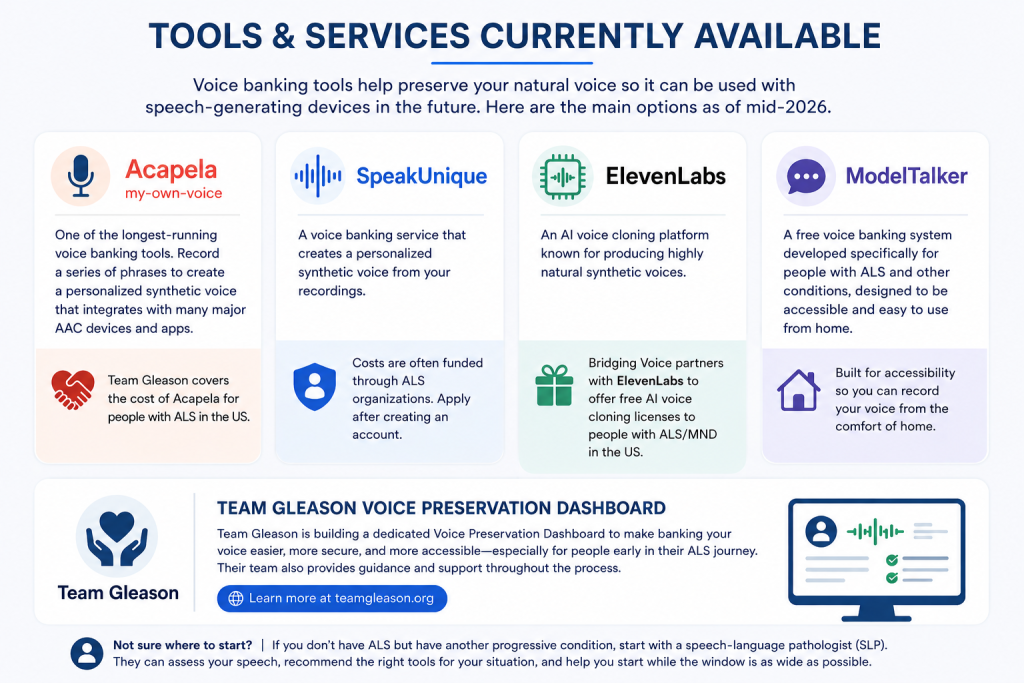
This field moves fast, and new tools continue to emerge. These are the main options as of mid-2026, but it is worth conducting your own current research or speaking with a speech-language pathologist before starting.
- Acapela My-Own-Voice: One of the longest-running voice banking tools. Record a set of phrases, and Acapela uses them to build a personalized synthetic voice that integrates with many major AAC devices and apps. It integrates with several major AAC (augmentative and alternative communication) devices and apps. Team Gleason, the nonprofit founded by former NFL player Steve Gleason to support people with ALS, often covers the cost of Acapela for people with ALS in the US.
- SpeakUnique: A voice banking service that creates a personalized synthetic voice from your recordings. Costs are often funded through ALS organizations. You can apply after creating an account.
- ElevenLabs: An AI voice cloning platform that has become one of the more powerful options for producing highly natural synthetic voices. Bridging Voice partners with ElevenLabs to offer free AI voice cloning licenses to people with ALS/MND in the US.
- ModelTalker: A free voice banking system developed specifically for people with ALS and other conditions, designed to be accessible and easy to use from home without needing to visit a clinic.
Team Gleason Voice Preservation Dashboard
Team Gleason is building a dedicated Voice Preservation Dashboard to make banking your voice easier, more secure, and more accessible, especially for people early in their ALS journey. Their team also provides guidance and support throughout the process. You can find more at teamgleason.org.
If you don’t have ALS but have a different progressive condition, a speech-language pathologist is the right first call. They can assess your current speech, recommend the right tools for your situation, and help you get started while the window is still wide.
The Part That Stays with You
Chris Johnson said something in that interview that I keep thinking about: “I want people to know that I’m still me. ALS has changed what my body can do, but it hasn’t changed who I am. People sometimes look at the physical disability and assume you’re not still the same person inside. I still think the same. I still dream.”
That line lands differently when you have a progressive condition yourself. Not because it’s sad, though it is. But because it’s exactly right. The condition changes what the body does, not the person inside it.
Your voice is part of how the people who love you know you. It carries your sense of humor, your particular way of landing a sentence, and the sound of you saying someone’s name. Voice banking doesn’t perfectly preserve all of that. The technology is good and getting better, but a synthetic voice is still a synthetic voice. What it preserves is enough to still sound like you, enough to still be recognizably yours, enough to still communicate in a voice your family and friends can recognize.
That’s worth doing early, not because the worst is coming. But because doing it now means you don’t have to think about it later. and later you’ll have other things to think about.
FAQ
It depends on the service. Some traditional voice banking tools require several hundred phrases to build a complete voice model. Newer AI-based services, including ElevenLabs, can work with far fewer recordings, sometimes as little as a few minutes of clear speech. The more you provide, the better the result.
Not necessarily. Even if your speech has changed, banking now produces better results than banking later. Some services can also work with existing recordings, interviews, videos, or other audio you may already have to supplement what you can record now. Speaking with a speech-language pathologist about your options is worth doing sooner rather than later.
No. Voice banking is relevant for anyone with a progressive neurological condition that may affect speech over time, including ataxia, Parkinson’s disease, multiple sclerosis, and others. Awareness of ALS is higher because speech loss can occur quickly, but the same logic applies to any condition where speech may change.
Coverage varies. Some AAC devices covered by insurance include voice banking features. Organizations such as Team Gleason, the Scott Morgan Foundation, and the MND Association offer free or subsidized access to voice banking services for eligible individuals. A speech-language pathologist or social worker familiar with your condition can help you navigate the options available to you.
Stay connected
If you found this useful, there’s more at the community page, with new articles as they’re published. And if you want to wear something that reflects where you are right now, the Life in Slow Motion tee at InspireThread is built around exactly that.
* This article is for informational purposes only and does not constitute medical advice. If you have questions about voice banking or speech changes related to your condition, consult a qualified speech-language pathologist or healthcare provider.








Great to see this article Mike! I’m doing voice banking with Eleven Labs, who is working with a charitable foundation to provide the services free of charge.
The voice pathologist first suggested it when I said that I don’t do podcasts anymore. She said with voice banking I could!
I have my old voice recorded from interviews ten years ago! What a fabulous solution.