


I saw the screenshot the same way many people probably did, as a post about a new gene therapy trial for Friedreich’s ataxia. “First patient dosed.” Big words. Big implications. The kind of headline that makes your nervous system lean forward for a second before your rational brain has a chance to catch up.
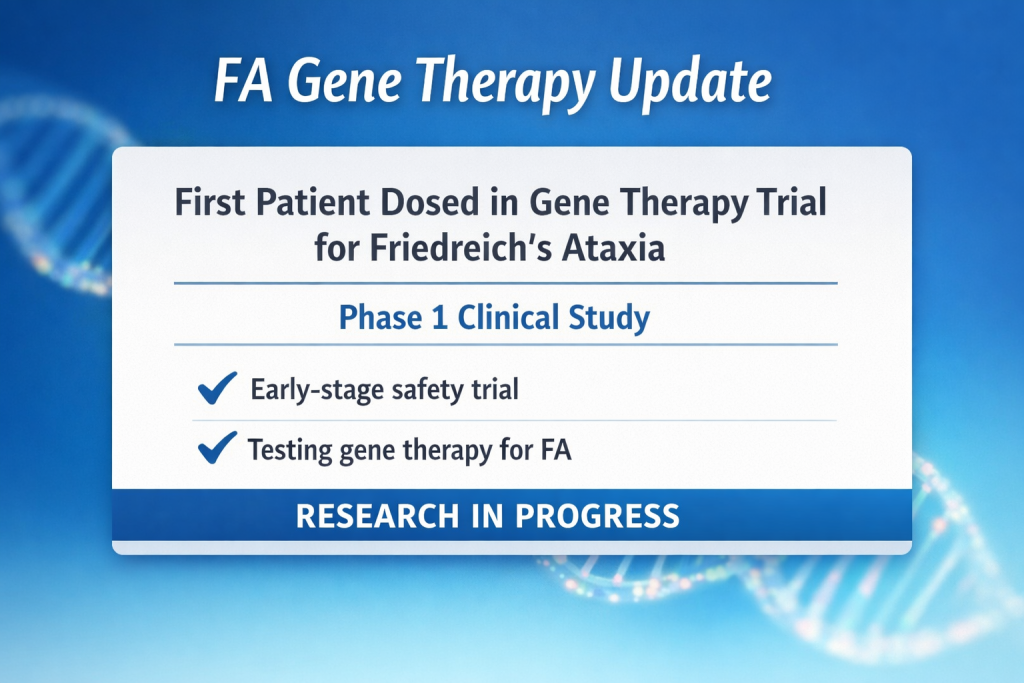
For a moment, it felt like one of those rare flashes of momentum people living with neurological conditions quietly hope for. Not a miracle. Not a finish line. Just movement in the right direction.
The momentum landed first. The specificity followed. Friedreich’s ataxia, not spinocerebellar ataxia. Not my diagnosis. A different branch of the same complicated tree.
It didn’t really feel like disappointment. It felt like perspective. A familiar reminder that progress in rare disease research doesn’t move evenly, and that headlines often move faster than reality. Still, the story itself matters. Not because it suddenly changes anyone’s treatment plan, but because it shows how progress actually unfolds – slowly, carefully, and in specific lanes.
If you live with ataxia, or care for someone who does, understanding how to interpret news like this can save a lot of emotional whiplash.
What This New Gene Therapy Trial Is Actually Testing (Phase 1 Explained)
What’s circulating right now is a gene therapy being tested in people with Friedreich’s ataxia. It’s still early, a Phase 1 trial, so this isn’t about proving anything yet. It’s about safety, how the body handles it, and making sure there aren’t any surprises.
When you hear that the “first patient has been dosed,” it simply means the treatment has moved out of the lab and into a real person for the first time. That’s an important milestone, but it’s also the very beginning of a long road. Many therapies never make it past this stage. Others take years of additional testing before anyone knows whether they actually change the course of the disease.
Gene therapy sounds futuristic, but the basic idea is simple: you’re trying to give the body a working version of something it’s missing. In Friedreich’s ataxia, the genetic issue is clearly defined, which makes this approach more realistic than for many neurological conditions.
None of this guarantees a cure. It doesn’t even guarantee improvement yet. It simply means the scientific process is doing what it’s supposed to do. Moving carefully from theory into real-world testing.
Why Friedreich’s Ataxia Research Advances Faster Than Many SCAs
One reason Friedreich’s ataxia tends to move faster is that it has a clear genetic cause and affects more people than many spinocerebellar ataxias. That makes it easier to design studies, find participants, and keep research moving.
Spinocerebellar ataxia isn’t one disease. It’s a family of many different genetic conditions, some of them extremely rare. In subtypes like SCA15, the biology doesn’t always line up cleanly with the same gene-replacement strategies being explored in Friedreich’s ataxia. That doesn’t mean progress isn’t happening. It just means the paths look different and often move more slowly.
That uneven pace can be frustrating when you’re waiting for something that applies directly to your own diagnosis. It’s also part of the reality of rare disease research. Biology doesn’t follow neat timelines. Funding doesn’t either.
If you’re newer to this world and want a broader foundation on how ataxia varies across types, I’ve written a deeper overview in What Is Ataxia, which may be helpful context.
The Emotional Whiplash of Medical Headlines
Even when you understand the science, your nervous system doesn’t always follow logic. Headlines still land in the body first. Hope shows up before nuance has time to catch up.
There’s a subtle emotional tax that comes from repeatedly seeing “breakthrough” language when you live with a chronic neurological condition. Each headline briefly lifts the possibility of change, even when you know it probably won’t affect you directly. Over time, that cycle can create quiet fatigue, not disappointment exactly, but a kind of low-grade emotional noise.
I’ve noticed that the longer I live with ataxia, the more I value steadiness over spikes of optimism. Big swings, even positive ones, cost energy. Learning how to regulate your relationship with medical news becomes part of managing the condition itself.
This reflects a pattern many people with neurological conditions experience. The nervous system becomes more sensitive not just physically but emotionally as well. If that resonates, you may also find value in how emotional load and nervous system stress show up in daily life in What You Don’t See.
What Progress Actually Looks Like in Ataxia Research
Progress in ataxia research rarely looks dramatic from the outside. It shows up in quieter ways: registries collecting better data, natural history studies clarifying how symptoms evolve over time, measurement tools getting more precise, and small improvements in symptom management. It also shows up through expanded access programs that allow patients to use promising therapies while formal approval continues.
I’m currently participating in an Expanded Access Program for troriluzole. Not because it’s a cure, but because incremental stabilization still matters. For many of us, slowing progression, preserving function, and maintaining quality of life are meaningful wins.
This kind of progress doesn’t generate viral headlines. But it quietly lays the foundation for future breakthroughs.
What This Means If You Don’t Have Friedreich’s Ataxia
If your diagnosis isn’t Friedreich’s ataxia, whether it’s SCA15, another SCA subtype, or a different neurological condition entirely, this trial still matters indirectly. It shows that advanced therapies are getting closer to being used in real people with neurological diseases. The tools being built, the approval process being tested, and the experience gained from running these trials all help move the field forward over time.
It’s normal to feel both encouraged and a little detached at the same time. A step forward for one subgroup doesn’t automatically translate into a solution for everyone else. But it does keep momentum moving in the right direction.
How to Read Medical Breakthrough Headlines Without Burning Out
A few simple filters can help keep medical news in perspective.
- First, always check the trial’s phase. Early human testing is about safety, not outcomes.
- Second, separate “potential” from “available.” Even successful therapies often take many years before becoming widely accessible.
- Third, remember that progress in rare diseases is uneven. One condition moving forward doesn’t mean another is being ignored. It reflects biological and logistical realities.
- And finally, it’s okay to step back from constant medical updates if they start to create anxiety or fatigue. Staying informed should support your nervous system, not overload it.
Final Thoughts
Seeing that screenshot didn’t change my treatment plan or expectations. What it did reinforce was something I keep coming back to: real progress tends to be quiet, patient, and unglamorous. It doesn’t announce itself with certainty. It earns trust over time.
Living well with ataxia often means learning how to pace not just your body, but your hope. Staying open to possibilities without letting headlines pull your nervous system around.Choosing steadiness over spectacle.
If you’re navigating this space yourself, you’re not alone in that balance.
Stay Connected
If you’d like grounded perspectives on living well with ataxia – real stories, practical tools, and steady progress – you can join the community here. You’ll get new articles, reflections, and resources as they’re published.
If you’re looking for simple ways to support awareness and research, you can also explore the Steady Steps collection in the InspireThread shop. A portion of the proceeds supports ataxia research and community initiatives.
Frequently Asked Questions
No. Gene therapies for ataxia are still in early research and clinical trial phases. The recent trial discussed in this article involves Friedreich’s ataxia and focuses on safety testing, not on treatment availability. No gene therapy is currently approved for any form of ataxia.
Not directly. Friedreich’s ataxia and spinocerebellar ataxias are different genetic conditions. A therapy developed for one type does not automatically translate to another. Research tools and experience may eventually benefit the broader field, but timelines vary widely.
From early human trials to approval often takes many years. Safety testing, dosing studies, larger efficacy trials, regulatory review, and manufacturing scale all take time. Most early trials never become approved treatments.
There is no cure for SCA. Treatment focuses on symptom management, physical therapy, adaptive strategies, and, in some cases, participation in clinical trials or expanded access programs for investigational medications.
Following trusted sources, limiting constant headline scanning, and focusing on long-term trends rather than individual announcements can help. It’s also important to balance staying informed with protecting emotional and nervous system health.
Medical disclaimer:
This article is for educational and informational purposes only and reflects personal experience and interpretation of publicly available research. It is not medical advice. Always consult your healthcare provider regarding diagnosis, treatment, or medical decisions.











Great article, Michael! Your points are so true, including those of us with love ones who have Friedreich’s Ataxia. ( I believe you know my daughter, Lily Pierce. ) Progress and promising studies give all of us HOPE for the future. Have a blessed day!
Thanks Ryan – Yes, I do know Lily and she writes some great articles!