

I’m thrilled to share this article by Franke James, an advocate, artist, and deep thinker whose work explores the intersection of technology(ChatGPT), health, and human experience. In it, Franke offers a unique perspective on how artificial intelligence might one day assist with movement disorders like Ataxia, not as a cure but as an innovative partner in problem-solving.
Her story of diagnosis, curiosity, and hope is a powerful reminder that sometimes, the answer lies in new ways of looking at old problems. Franke’s approach is equal parts creative, practical, and deeply human. I’m grateful to her for bringing this conversation forward.
If you have a story, perspective, or experience you’d like to share, I invite you to reach out. Together, we can amplify more voices, spark meaningful discussions, and build a community of awareness and resilience.
Franke’s article:
Some might recoil in horror at the idea of body parts (especially the brain!) being replaced by AI. Society is already wringing its hands with worry that AI is making us all dumber. Yet, rather than eroding our intelligence, I’m imagining that AI could help us leapfrog to new advancements—and I have a compelling and painful inspiration.
In 2024, I fell on a small step at night and dislocated my shoulder. The fall came without warning, and I crashed to the ground harder than I ever thought possible. It wasn’t the first time I’d lost my balance, but it was the most serious. The injury—and the growing sense that something wasn’t quite right—pushed me to dig deeper.
Months later, I discovered the six-letter word that explained my health mystery: ataxia. The brain’s cerebellum is the big culprit in ataxia. It plays a huge role in balance, coordination, and motor control. But what happens when it stops working as it should?
That’s when I turned to AI—not as a cure, but as a sounding board.
My muse. Many people are looking to drugs and the pharmaceutical industry to solve the ataxia problem, but what if the answer was AI? I asked: Is anyone studying cerebellum organ donations? Could mine be swapped out, like a faulty part?
Like a smart research assistant, ChatGPT scoured global scientific medical resources. It answered: “while the cerebellum isn’t transplanted like a kidney or heart, researchers do collect it through brain donation programs. Organizations like the Paris Brain Institute (France)[1], the Canadian Concussion Centre – Brain Donation Program[2], and the NIH NeuroBioBank (United States)[3] are studying the cerebellum to better understand movement disorders, neurodegeneration, and ataxia. The donated tissue helps scientists understand what went wrong and how it might be treated.”
Ouch! If they were to study my cerebellum, I’d be dead by that point. I searched for a living answer. Could the cerebellum someday benefit from a gizmo—something that works like a pacemaker does for the heart?
ChatGPT responded that we’re not yet at the point where the cerebellum can use something like a pacemaker.
But it pointed out that stimulation techniques—like deep brain stimulation (DBS)[4] and transcranial magnetic stimulation (TMS)[5]—as well as wearable devices and neuroprosthetics, are advancing rapidly. In a few decades (too late for me!), it said, a form of cerebellar modulation or assistance might be feasible. It would likely be an augmentation rather than a replacement, but it could help people regain balance and coordination.
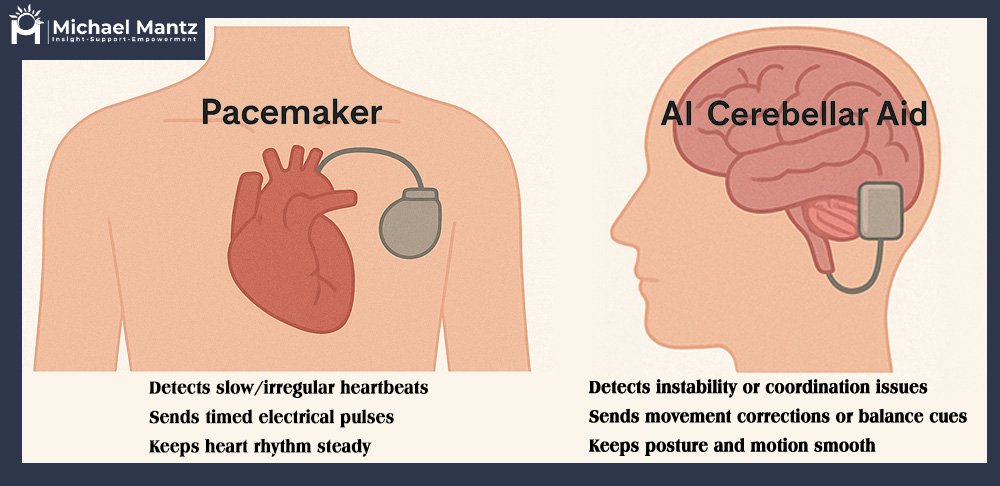
For comparison, ChatGPT explained to me how a pacemaker works: It detects slow or irregular heartbeats and sends timed electrical pulses to keep the rhythm steady. It doesn’t replace the heart—it supports it. The cerebellum, it said, is like a stability control system in the brain. If it falters, an assistive device might someday nudge it back into rhythm, much like a pacemaker keeps a heartbeat in sync.
I pushed further: Could AI replace my cerebellum someday?
“That’s a question that sits at the cutting edge of neuroscience, artificial intelligence, and bioengineering,” said ChatGPT. (Ahem, my muse is often flattering!)
It explained that the cerebellum is like a biological processor that works below conscious awareness to fine-tune motion. Replacing it would mean creating an AI system that could process real-time input, predict instability, and adjust movement on the fly.
“Maybe,” ChatGPT said. “AI could replace your cerebellum in part. And far in the future.” Right now, we’re at the early experimental stages. But the convergence of neuroscience, machine learning, and neuroengineering is opening doors we couldn’t have imagined even a decade ago.
Then it gave me a metaphor that made everything click. It was simple—but elegant.
“Imagine your body as a car. The brain is the driver, making decisions like when to stop or turn. The cerebellum is the car’s stability control system, making micro-adjustments automatically. If the cerebellum is damaged, it’s like that system has gone offline. The ride becomes jerky, unpredictable. But what if an AI-based system could fill in the gaps? Sensors on your body could detect instability, and a tiny processor could send real-time commands to correct your posture—like a backup autopilot. It wouldn’t be a cure, but it could keep you upright.”
That sounds like science fiction in 2025. But the truth is, the far-off future of an AI-cerebellar-aid is already present today. It helps me to be thorough—digging into medical questions and organizing research. It’s not implanted in my brain, but AI is useful to me in so many ways. It doesn’t replace my cerebellum (yet)—but it does something powerful. It gives me optimism about the marvels that may one day be reality.
Closing:
If Franke’s story resonated with you, I’d love to hear your thoughts. Whether you’re navigating Ataxia, exploring innovative solutions, or simply curious about where technology and health intersect, your perspective matters. Join us—because raising awareness and building a stronger, more connected community starts with sharing our stories and having the courage to ask bold questions.
Franke James provided the Chat GPT image.
Footnotes:
- https://parisbraininstitute.org/disease-files/ataxias
- https://www.uhn.ca/Krembil/Canadian-Concussion-Centre/Brain-Donation
- https://neurobiobank.nih.gov
- https://www.mayoclinic.org/tests-procedures/deep-brain-stimulation/about/pac-20384562
- https://www.mayoclinic.org/tests-procedures/transcranial-magnetic-stimulation/about/pac-20384625









Thanks Michael. I hope people enjoy my article and it inspires new research ideas! Scientific American has a brand new article today on a similar tack: “What would it take to create a cyborg brain like the one in the new TV show Murderbot? ” (Paywall) https://www.scientificamerican.com/article/murderbots-cyborg-brain-explained-by-neuroscience/?utm_source=Klaviyo&utm_medium=campaign&utm_campaign=Mind%20%26%20Brain%205%2F21%2F25&utm_term=It%27s%20not%20just%20the%20stuff%20of%20sci-fi&_kx=E_e5Dl9ZPKofZODmShIMGmTR0sAnhTGH5tMyIhsuNFE.WEer5A