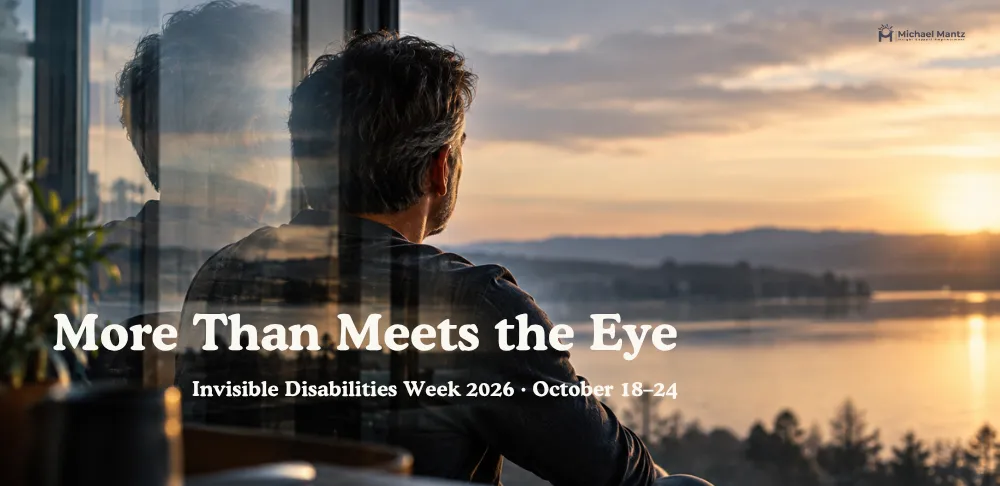
Invisible Disabilities Week 2026 | October 18–24
Last Saturday, my balance was much worse than usual. I’d slept well, and nothing particularly stressful was going on. Living with Ataxia, I’m no stranger to being unsteady on my feet, but this was different. For most of the day, I couldn’t stand without holding on to something.
I’ve had plenty of days when my coordination wasn’t cooperating, but I couldn’t remember one this bad lasting all day. I kept wondering what had changed. Had I done something differently? Did I overlook something? Nothing came to mind.
Then Sunday arrived, and my balance was back to its usual level. I still had Ataxia, of course, but whatever had made Saturday so difficult seemed to have passed. If you’d seen me on Sunday, you might have noticed my unsteady gait. You wouldn’t have known what the previous day was like, or that I spent much of it holding on to something just to stay standing.
I’ve been thinking about that experience because October 18–24 is Invisible Disabilities Week. I’ve written about this before, but Saturday reminded me that even when a disability is visible, much of what it entails isn’t.
What You Can See, and What You Can’t
Ataxia isn’t entirely invisible, at least not in my case. I have SCA15, a form of spinocerebellar ataxia that affects my balance, coordination, walking, and other everyday movements. The National Ataxia Foundation provides information on how Ataxia affects people, and symptoms can vary considerably.
When I walk, people can usually tell something is different. Sometimes my speech gives it away, too, though what someone makes of those differences is another question entirely. Someone might notice my unsteady gait without realizing how much effort it takes. They might also see me getting around reasonably well on Sunday and assume that’s how things always are. I can hardly blame them. They’re working with the information they have.
I don’t expect strangers to know my medical history. Frankly, I’d be a little concerned if someone standing behind me in the grocery store knew that much about me. But Ataxia is only part of what I’m living with. But Ataxia is only part of what I’m living with.
I also have ankylosing spondylitis, an inflammatory form of arthritis that primarily affects the spine and surrounding joints. According to the National Institute of Arthritis and Musculoskeletal and Skin Diseases, part of the National Institutes of Health, the condition can cause pain, stiffness, and limitations in movement.
I’ve lived with pain every day since 1999.
That’s about 27 years of going to work, spending time with friends, making plans, and doing all the ordinary things that make up a life, all while dealing with something most people can’t see. I can be sitting across from someone, enjoying lunch and having a great conversation, while in pain the entire time. I’ve learned to live around it, and I imagine many people dealing with chronic pain have done the same.
When Yesterday Doesn’t Tell You Much About Today
One thing I’ve learned about living with Ataxia is that yesterday isn’t always a reliable guide to today. I generally know what to expect from my balance and coordination, but some days are noticeably better or worse. Saturday was an unusually dramatic example, and I still don’t know what caused it.
That uncertainty can be frustrating. It’s hard enough to manage a condition you understand, but when something changes without an obvious reason, you’re left trying to figure out whether it’s temporary, caused by something you did, or worth worrying about.
I think this is where people who haven’t lived with a chronic condition can struggle to understand what they’re seeing. If someone watched me manage an activity comfortably yesterday, it’s reasonable for them to expect I could do the same today. I might expect it myself. But sometimes my body has other plans.
Of course, this isn’t unique to Ataxia. Someone with chronic fatigue may have enough energy to spend an afternoon with friends but need a long time to recover afterward. A person living with chronic pain may manage an activity one day and struggle with it the next. Others have limitations that remain fairly consistent, even if those limitations aren’t obvious to those around them. Experiences differ, and I don’t want to suggest that every invisible disability involves unpredictable symptoms. But they share something important: what another person sees at a particular moment may tell them very little about the effort, discomfort, or limitations involved.
What I Hope Awareness Helps Us Understand
That’s where Invisible Disabilities Week offers something worthwhile. Most people aren’t deliberately dismissing others’ difficulties. They’re going about their lives, making decisions, and trying to understand the people around them. We all do it, and we all make assumptions based on what we see. The trouble comes when we become so confident in those assumptions that we stop considering what we might not know.
Maybe someone turns down an invitation because they’re exhausted. Instead of taking it personally, we might consider that getting through the day took more energy than we realized. Or perhaps someone needs an accommodation that seems unnecessary given what we’ve seen them do before. We don’t have to understand every detail of their condition to accept that they know what they need. And if someone seems unsteady on their feet, it might be worth resisting the urge to decide right away what’s wrong.
I also think awareness should make everyday interactions easier, not more awkward. I don’t want people to treat me as if every movement requires supervision, and I certainly don’t want to spend my life explaining why I walk the way I do. If I need help, I’d much rather someone ask than make decisions for me.
Ultimately, I don’t think awareness means recognizing every disability or knowing exactly what to say in every situation. It’s about becoming a little more willing to listen, ask when appropriate, and accept that another person’s experience may differ from what we imagine.
A Little More Than Meets the Eye
I’ve written before about how awareness matters most when it leads somewhere. This week is another opportunity to put that idea into practice, even in small ways. I’m not sharing any of this to make people see me differently. I’d much rather they get to know me for who I am, including the parts of my life that have nothing to do with a diagnosis.
But I do hope we can get better at recognizing how much of another person’s life we don’t see. Because there’s usually more to the story than what happens to be in front of us.
Stay Connected
I write about living with Ataxia, the unexpected ways life changes, and the lessons we can learn from experiences we never planned. If that interests you, I’d love for you to join the community.

You can also explore the Rare Aware Tee from InspireThread, which has a small “rare aware” print on the front pocket and “Where story meets strength” on the back. It’s one small way to keep the conversation going, and a portion of every sale supports rare disease research. Grab yours here.