



I recently came across an article about a backpack built with real aerospace technology. It uses the same gyroscopic principle that keeps satellites oriented in orbit, and is designed specifically to help people with ataxia stand and walk more steadily. It’s the kind of headline that sounds made up until you read the actual study behind it. It isn’t. But it’s also not quite what the headline makes it sound like. So I wanted to walk through both parts here.
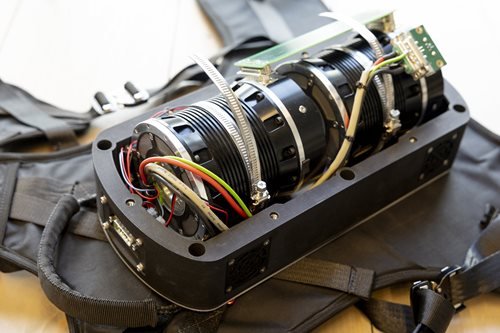
*The backpack, known as the Gyropack, uses gyroscopic technology similar to that used in space stations or large satellites to maintain orientation in space. Photo: Delft University of Technology (image taken from the Radboudumc website)
What It Actually Is
Teams at Radboud University Medical Center, Delft University of Technology, and Erasmus MC in the Netherlands built the device, called the Gyropack. It grew out of gyroscopic work those teams had already been developing for over a decade, before anyone thought to point it at ataxia specifically.
The mechanism itself is simpler than it sounds. Inside the pack are two spinning flywheels, gyroscopes that resist unwanted rotation. Satellites use the same basic principle to stay oriented in space without anything to push against. Here, the same resistance is directed at the torso. Specifically, it counters the kind of trunk wobble that shows up in ataxia. That’s worth sitting with for a second, because most balance aids, such as canes, walkers, and gait trainers, are built around the legs and feet. This is one of the few tools I’ve come across that’s engineered around the trunk itself, the part of the body most affected in my own presentation, and one that gets comparatively little dedicated research attention.
One detail in the researchers’ reasoning also stuck with me: part of the motivation was that walkers, while functional, are heavy, cumbersome, and perceived by many as stigmatizing. The Gyropack was conceived, in part, to help people stay steady without visibly signaling that they need help. Whether that succeeds in practice is a separate question, but it’s a thoughtful starting point for a design brief.
How the Study Was Tested
Researchers tested the backpack on fourteen people with moderate to advanced ataxia, comparing three conditions: no backpack, an active backpack, and a sham version rigged to sound and feel identical to the real thing without doing anything useful. That sham condition is what makes this real science rather than a neat demo. It’s what separates “this might just be a heavy bag making people feel steadier” from an effect you can actually measure and trust.
The results held up. Even the inactive backpack helped a little, likely just from its weight of about six kilograms, which stabilized the upper body on its own. But the meaningful improvement appeared specifically when the gyroscopes were active: increased standing time, straighter walking, and less variability in trunk motion. Lead researcher Jorik Nonnekes described participants as visibly more stable, walking in a straight line more effectively than they could without it.
Why I’m Not Ordering One
Because you can’t. The prototype currently runs at about 86 decibels, loud enough to be genuinely annoying in a normal room. It also weighs around six kilograms, or thirteen pounds, which isn’t something anyone’s casually throwing on for a trip to the grocery store. Even the researchers admit it isn’t ready for daily use yet. A lighter, quieter version is the clear next step.
The Part Worth Being Honest About
The study this is based on was published in August 2025. That’s over a year old now. As far as I can tell, it hasn’t advanced publicly since then. I looked for a follow-up trial, a funding announcement, a next-generation prototype, or anything indicating the “make it lighter and quieter” phase had actually begun. I couldn’t find any. Every recent mention I came across was just another write-up of the original study, not new progress.
I want to be clear about what that does and doesn’t mean. This was a real, peer-reviewed study, not vaporware or hype dressed up as science. The sham-controlled design alone shows the researchers were serious about proving something real, not just generating a good headline. But it’s still right where it was when it was published: proof of concept, with next steps that, as far as I can tell, haven’t actually begun. No funding announcement, no timeline, no update. Worth saying plainly, rather than letting a good headline imply progress that isn’t actually happening.
Why It’s Still Worth Knowing About
Even sitting still, I think this is worth keeping on your radar, mostly for what it represents rather than what it currently does. Trunk-based instability, the kind I’ve written about before, rarely receives dedicated research attention. A team specifically targeting torso stability, using genuinely novel engineering, signals that the research field is paying attention to a part of ataxia that is usually overlooked in favor of gait.
Research stalling after an initial study isn’t unusual, and it isn’t necessarily a bad sign. Early-stage devices often sit for a while between proof of concept and the next round of funding, and that gap doesn’t mean the work has been abandoned. But I’d rather tell you that plainly than let this read as if it’s actively in development, when the honest answer right now is that nobody’s said much publicly since.
A Few Questions People Ask About This
Is the Gyropack available to buy or try? No. It exists only as a research prototype used in a controlled study. There’s no public timeline for when or if a consumer or clinical version will become available.
Does this help all types of ataxia? The study tested people with moderate-to-advanced degenerative ataxia broadly, not a specific genetic type. Whether the effect holds consistently across every form, including SCA15, isn’t something this single study can answer.
Why does trunk-specific research matter so much? Because most existing assistive devices focus on gait and leg support. A tool engineered specifically for torso instability addresses a gap that many standard ataxia devices don’t address.
Where This Leaves Things
Mostly, keep an eye on it. If Radboudumc or the TU Delft team publish anything new, I’ll cover it here. For now, this stays in the category of research worth knowing exists, not something with a timeline. That’s most of what R&D coverage looks like day to day: interesting ideas, real data, and a lot of quiet, unglamorous waiting in between.
Stay Connected
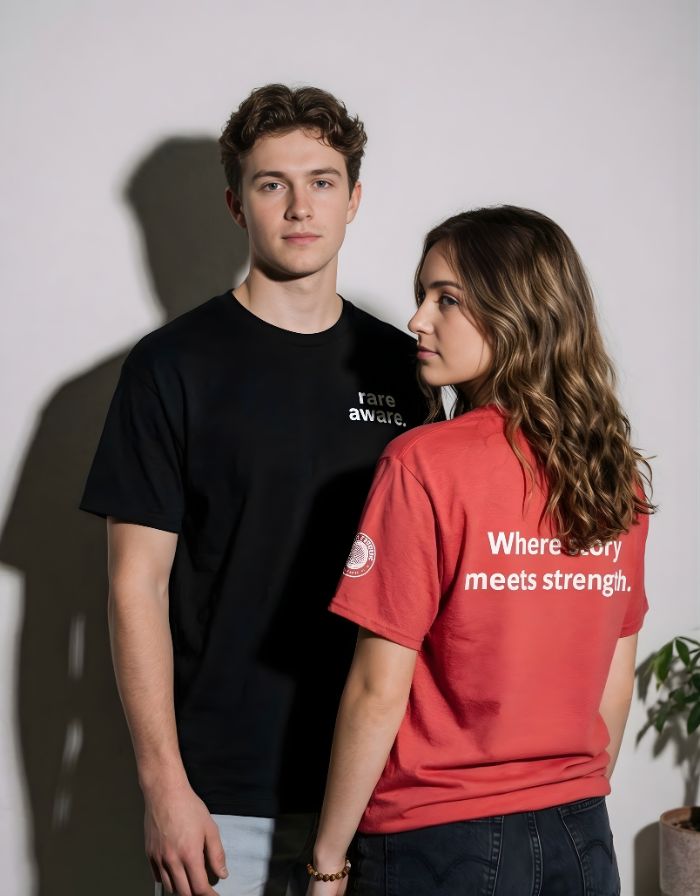
If research like this is useful to you, even in its early, unresolved form, join the community for updates when there’s something new to report. And if you want something a little steadier to wear in the meantime, one that doesn’t require batteries or make noise, the Rare Aware Tee is a quieter way to say something true. A portion of every sale supports rare disease research.










